
For the Love of Grass
By
Curtis Sharp, Bob MacLauchlan, Jack Carlson and Wendall Oaks
Four friends and colleagues traversed three states and 2000 miles simply for the love of viewing plants in their native environment. Our principal destinations were the Flint Hill of Kansas and the Sandhills of Nebraska. This is a brief summary of what we saw and where we saw our plant friends.
We assembled in Julesburg, CO about noon on September 9, 2008, and departed shortly thereafter.
Day 1, Observational Stops 1 – Western Kansas
Our destination for the evening was Garden City, KS. Our route took us south on US 385, then east into Kansas on US 34. We made three stops; one just north of St. Francis, one just north of Scott City, KS and our last stop was the Sandsage Bison Range and Wildlife Area, slightly southwest of Garden
City KS. All the plants we saw at the three sites are listed below. Although the Sandsage Bison Range and Wildlife Area site was disappointing in that the range was badly infested with a host of invasive plants, it contained multiple species.
Species identified among the three stops included:
Grasses
Andropogon gerardii Vitman big bluestem
Andropogon hallii Hack. sand bluestem
Bothriochloa ischaemum (L.) Keng yellow bluestem
Bothriochloa laguroides (DC.) Herter ssp. Lluestemaguroides silver bluestem
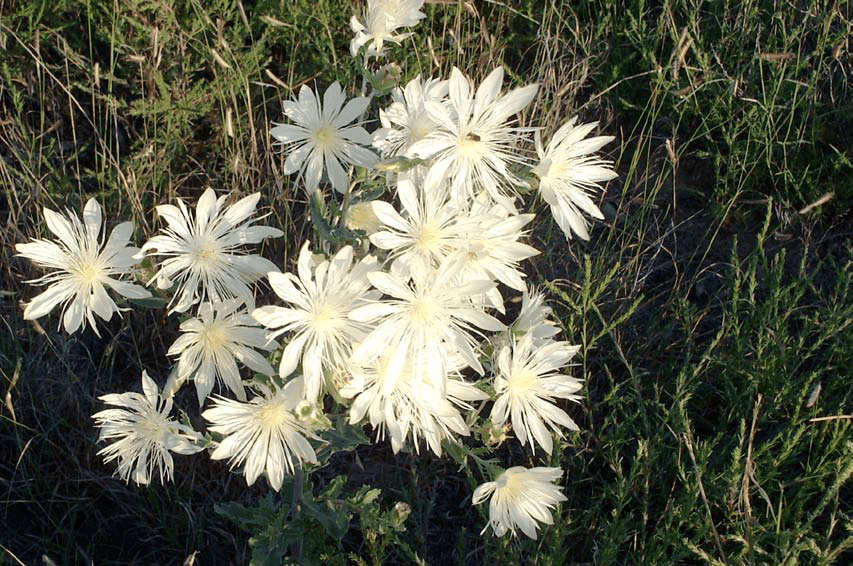
Tenpetal blazingstar at Sandsage Bison Range and Wildlife Area
Bouteloua curtipendula (Michx.) Torr. sideoats grama
Bouteloua dactyloides (Nutt.) J.T. Columbus buffalograss
Bouteloua gracilis (Willd. ex Kunth) Lag. ex Griffiths blue grama
Eragrostis trichodes (Nutt.) Alph. Wood sand lovegrass
Schizachyrium scoparium (Michx.) Nash little bluestem
Sorghastrum nutans (L.) Nash indiangrass
Sporobolus cryptandrus (Torr.) A. Gray sand dropseed
Panicum virgatum L. switchgrass
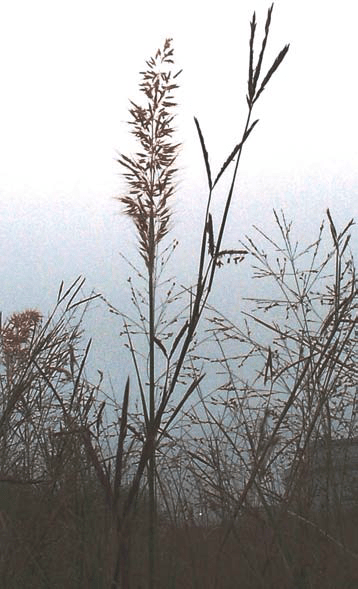
Seed heads of indiangrass and big bluestem, with some switchgrass in background
Legumes, Forbs, Shrubs, and Trees
Artemisia filifolia Torr. sand sagebrush
Desmanthus illinoensis (Michx.) MacMill. ex B.L. Rob. & Fernald
Illinois bundleflower
Euphorbia marginata Pursh snow-on-the-mountain
Grindelia squarrosa (Pursh) Dunal curlycup gumweed
Gutierrezia sarothrae (Pursh) Britton & Rusby broom snakeweed
Helianthus annuus L. common sunflower
Liatris aspera Michx. tall blazing star
Mentzelia decapetala (Pursh ex Sims) Urb. & Gilg ex Gilg tenpetal blazingstar
Rhus trilobata Nutt. skunkbush sumac
We retired for the evening in Garden City, KS
Day 2, Observational Stop 2 – The Belpre Wayside
On the morning of September 10 we proceeded east, had breakfast in Dodge City, and continued towards Hutchinson, KS. Zooming along, near Belpre a most robust native grass prairie was observed on the north side of Route US 50. We stopped and were delighted with what we found. It was not being grazed, and could be a CRP planting. The four horseman, switchgrass, big and little bluestem and indiangrass were the dominate species, with switchgrass the most dominate. Several plants exceeded 7 feet. Plants identified:
Grasses
Andropogon gerardii Vitman big bluestem
Panicum virgatum L. switchgrass
Schizachyrium scoparium (Michx.) Nash little bluestem
Sporobolus airoides (Torr.) Torr. alkali sacaton
Sorghastrum nutans (L.) Nash Indiangrass
Forbs
Lotus unifoliolatus (Hook.) Benth. American bird’s-foot trefoil
Solanum L. nightshade
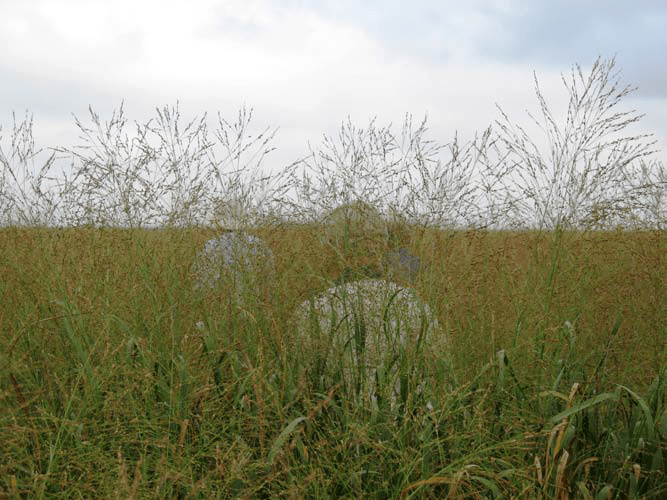
Very tall grass, and it is switchgrass
Day 2, Observational stop 3 – Dillon Nature Center
From The Belpre Wayside we proceed to the Dillon Nature Center
From The Belpre Wayside we proceed to the Dillon Nature Center, just on the northeast edge of Hutchinson, KS. What a gem. We found:
Grasses
Andropogon gerardii Vitman big bluestem
Bouteloua curtipendula (Michx.) Torr. sideoats grama
Eragrostis trichodes (Nutt.) Alph. Wood sand lovegrass
Panicum virgatum L. switchgrass
Schizachyrium scoparium (Michx.) Nash little bluestem
Sorghastrum nutans (L.) Nash Indiangrass
Tridens flavus (L.) Hitchc. purpletop tridens
Legumes, Forbs, Shrubs
Agalinis aspera (Douglas ex Benth.) Britton tall false foxglove
Chamaecrista fasciculata (Michx.) Greene partridge pea
Cirsium altissimum (L.) Hill tall thistle
Commelina erecta L. whitemouth dayflower
Croptilon hookerianum (Torr. & A. Gray) House var. graniticum (E.B. Sm.) E.B. Sm.
Hooker’s scratchdaisy
Froelichia floridana (Nutt.) Moq. plains snakecotton
Gaillardia aestivalis (Walter) H. Rock var. aestivalis lanceleaf blanketflower
Helianthus maximiliani Schrad. Maximilian sunflower
Lespedeza capitata Michx. roundhead lespedeza
Oenothera biennis L. common evening primrose
Salvia azurea Michx. ex Lam. var. grandiflora Benth. pitcher sage
Solidago altissima L. Canada goldenrod
Verbena stricta Vent. hoary verbena
There were other species believed to be introduced:
Bothriochloa bladhii (Retz.) S.T. Blake Caucasian bluestem
Hippuris vulgaris L common mare’s-tail
Upon leaving Dillon Nature Center one member of our foursome recalled leaving his coat at the Center, so we returned. Of course we will never mention his name.

Day 2, Observation Stop 4 – Tallgrass Prairie National Preserve, School Site
Our arrival in Cottonwoods Falls was near sunset on September 10th. But our zeal drove us to the Tallgrass Prairie National Preserve, mostly acquired by the Nature Conservancy and operated by the National Park Service. Available daylight suggested a short visit instead to the Lower Fox Creek School, which was part of the Preserve. The site for the schoolhouse was donated by Stephen F. Jones, former owner of the ranch which is now part of the Tallgrass Prairie National Preserve. The deed stipulated that the property would revert back to the ranch owner when the place was no longer used as a school. The first school term began on September 1, 1884, and closed in 1930.
Lower Fox Creek School
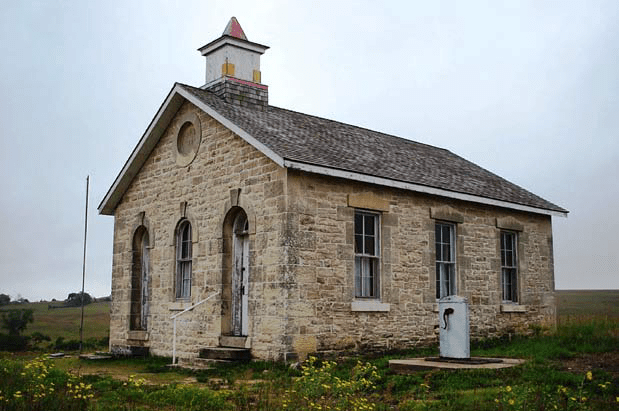
Visiting the school did not damper our plant identification spirit. In the school yard and surrounding area we observed several plants, and identified those below.
Grass
Bouteloua curtipendula (Michx.) Torr. sideoats grama
Forbs
Gaura longiflora Spach longflower beeblossom
Helianthus annuus L. common sunflower
Liatris punctata Hook. dotted blazing star
Salvia azurea Michx. ex Lam. var. grandiflora Benth. pitcher sage
Solidago altissima L. Canada goldenrod
Day 3, Observational Stop 5 – Tallgrass Prairie National Preserve and Surrounding Countryside
In the Flint Hills, we drove south on Highway 177, stopping at a rest stop before the Bazaar turn-off.
Then a left turn through the village of Bazaar following the back roads denoted on the maps contained in the Prairie Eyrth book by William Least-Heat Moon, English professor at the University ofMissouri. Then past the Kansas Turnpike and around to Matfield Green, then north on 177 past the Knute Rockne crash site through Cottonwood Falls to the Tallgrass Prairie National Preserve.
Plants identified on the route, including the Tallgrass Prairie National Preserve bus tour, are below.
Grasses
Andropogon gerardii Vitman big bluestem
Bouteloua curtipendula (Michx.) Torr. sideoats grama
Bouteloua gracilis (Willd. ex Kunth) Lag. ex Griffiths blue grama
Eragrostis trichodes (Nutt.) Alph. Wood sand lovegrass
Panicum virgatum L. switchgrass
Schizachyrium scoparium (Michx.) Nash little bluestem
Sorghastrum nutans (L.) Nash Indiangrass
Spartina pectinata Bosc ex Link prairie cordgrass
Sporobolus heterolepis (A. Gray) A. Gray prairie dropseed
Tridens flavus (L.) Hitchc. purpletop tridens
Legumes, Forbs, Shrubs
Amorpha canescens Pursh leadplant
Artemisia filifolia Torr. sand sagebrush
Helianthus annuus L. common sunflower
Oenothera macrocarpa Nutt. bigfruit evening primrose
Salvia azurea Michx. ex Lam. var. grandiflora Benth. pitcher sage
Solidago altissima L. Canada goldenrod
Symphoricarpos orbiculatus Moench coralberr
Amphiachyris dracunculoides (DC.) Nutt. prairie broomweed
Nepeta cataria L. catnip
The following exotic species were observed. The broomweed infestation was severe.

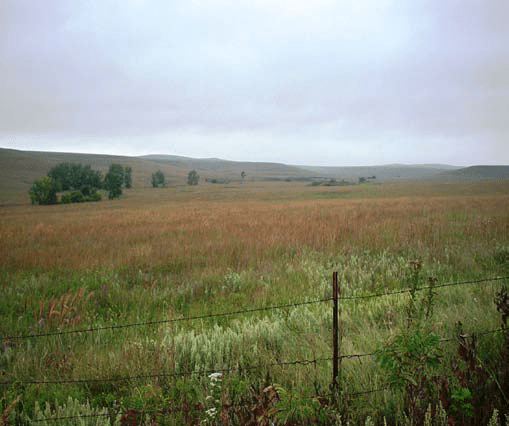
The broomweed is in the foreground of the left picture. Most of the plants in the background of both pictures are indiangrass.
We enjoyed a nice lunch in Cottonwood Falls, and had the good fortune to bump into our lodging proprietor of the following evening. It was fortunate in that he advised us of the items left behind, which we recovered. From there we proceeded north to the Konza Prairie, just south of Manhattan, KS.
Day 3, Observation Site 6 – Konza Prairie Biological Station, Kansas State University
This was a delightful site. The Konza Prairie Long-Term Ecological Research has an education and outreach program about one of the most productive grasslands in North America, the tallgrass prairie.
The Konza Prairie program began 1982 with a focus on fire, grazing, and climatic variability as three key drivers that affect ecological pattern and process in grasslands worldwide.
Plants identified included:
Grasses
Andropogon gerardii Vitman big bluestem
Bouteloua curtipendula (Michx.) Torr. sideoats grama
Bouteloua gracilis (Willd. ex Kunth) Lag. ex Griffiths blue grama
Eragrostis trichodes (Nutt.) Alph. Wood sand lovegrass
Panicum virgatum L. switchgrass
Schizachyrium scoparium (Michx.) Nash little bluestem
Sorghastrum nutans (L.) Nash Indiangrass
Sporobolus heterolepis (A. Gray) A. Gray prairie dropseed
Tridens flavus (L.) Hitchc. purpletop tridens
Legumes, Forbs, Shrubs, Trees
Allium stellatum Fraser ex Ker Gawl. autumn onion
Ceanothus americanus L. New Jersey tea
Eupatorium altissimum L. tall thoroughwort
Helianthus annuus L. common sunflower
Helianthus maximiliani Schrad. Maximilian sunflower
Helianthus tuberosus L. Jerusalem artichoke
Liatris punctata Hook. dotted blazing star
Oenothera macrocarpa Nutt. bigfruit evening primrose
Oligoneuron rigidum (L.) Small var. glabratum (E.L. Braun) G.L. Nesom
stiff goldenrod
Quercus macrocarpa Michx. bur oak
Rhus trilobata Nutt. skunkbush sumac
Rhus glabra L. smooth sumac
Salvia azurea Michx. ex Lam. var. grandiflora Benth. pitcher sage
Solidago altissima L. Canada goldenrod
Stenosiphon linifolius (Nutt. ex James) Heynh false gaura
Verbena stricta Vent. hoary verbena
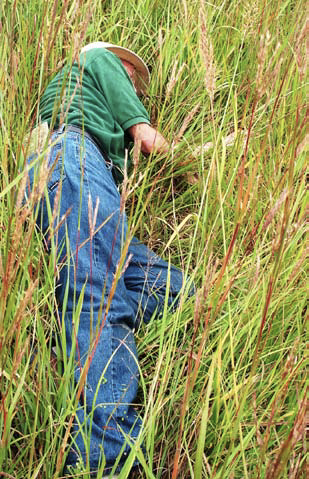
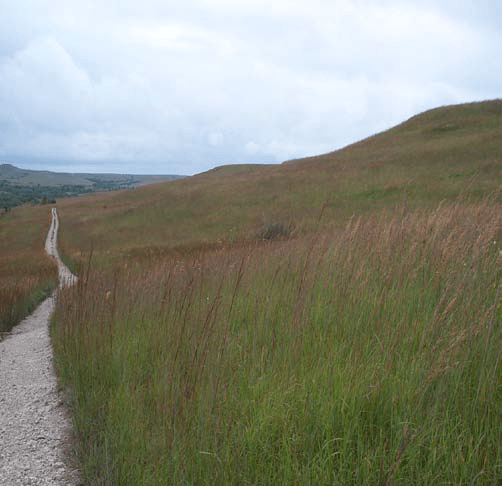
Some members of the group were so overcome with the grass they chose to lie down and roll in it, appropriately dubbed Homo sapiens ssp. wallowensis. We all marveled at its beauty.
We retired for the evening in Manhattan.
Day 4, Observational Site 7 – NRCS Manhattan Plant Materials Center
September 12 was the undesignated rain day, which it did. We enjoyed a morning visit at the NRCS Plant Materials Center, reviewing their activities and physical plant. Unfortunately, the downpour kept us out of the fields.
Day 4, Observational Site 8 – Homestead National Monument
By late morning we departed, drove north into Nebraska, then west to Beatrice, Nebraska and the Homestead National Monument. We took in the displays and short movie, then out to circumnavigate the 100 acre restored prairie.
Grasses
Andropogon gerardii Vitman big bluestem
Sorghastrum nutans (L.) Nash Indiangrass
Spartina pectinata Bosc ex Link prairie cordgrass
Forbs, Trees
Maclura pomifera (Raf.) C.K. Schneid. osage orange
Populus deltoides Bartram ex Marsh. ssp. monilifera (Aiton) Eckenwalder
plains cottonwood
Solidago altissima L. Canada goldenrod
And one dominant introduced grass:
Bromus inermis Leyss. smooth brome.

Daniel and Agnes Freeman were the first homesteaders arriving 1863. The museum is in the background.
Day 5, Observational Site 9 – Willa Cather Memorial Prairie, Red Cloud, NB
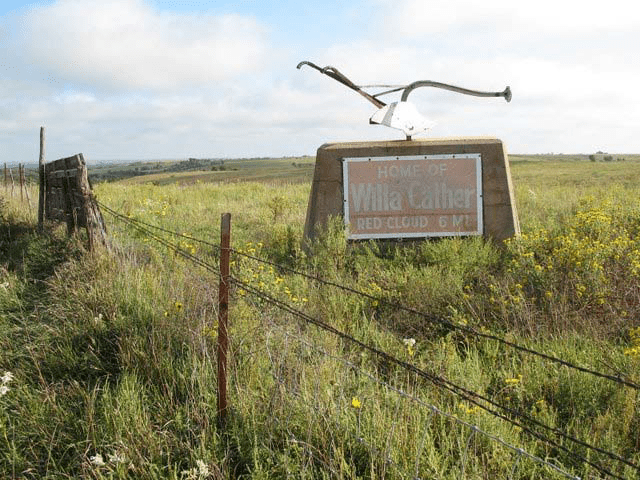
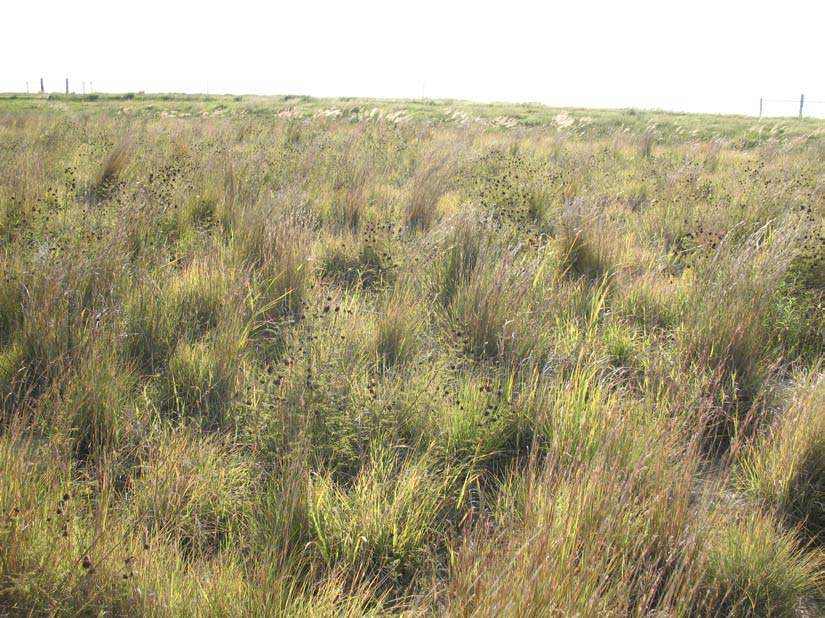
Saturday morning, September 13, broke clear in Red Cloud, NB. We were off to the Willa Cather Memorial Prairie 5 miles south of town. This prairie was established in the spring of 2006 in order to “– restore and conserve the rare native grasses, plant life, and wildlife of its delicate ecology”. It had previously been grazed at varying intensities, which were reflected in the vegetation, as shown below.
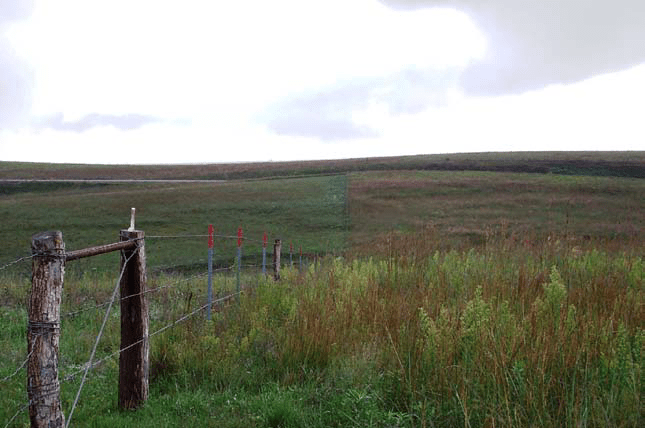
Plants observed were similar but not identical to those at the Konza Prairie. The two new species observed are listed first.
Onosmodium bejariense DC. ex A. DC. soft-hair marbleseed
Astragalus canadensis L. Canadian milkvetch
Repeats included:
Grasses
Andropogon gerardii Vitman big bluestem
Bouteloua curtipendula (Michx.) Torr. sideoats grama
Bouteloua gracilis (Willd. ex Kunth) Lag. ex Griffiths blue grama
Eragrostis trichodes (Nutt.) Alph. Wood sand lovegrass
Panicum virgatum L. switchgrass
Schizachyrium scoparium (Michx.) Nash little bluestem
Sorghastrum nutans (L.) Nash Indiangrass
Sporobolus heterolepis (A. Gray) A. Gray prairie dropseed
Tridens flavus (L.) Hitchc. purpletop tridens
Legumes, Forbs, Shrubs, Trees
Eupatoriadelphus fistulosus (Barratt) King & H. Rob. Trumpetweed (Joe-Pye weed)
Euphorbia marginata Pursh snow on the mountain
Juniperus virginiana L. eastern redcedar
Oligoneuron rigidum (L.) Small var. glabratum (E.L. Braun) G.L. Nesom
stiff goldenrod
Rhus typhina L. staghorn sumac
Salvia azurea Michx. ex Lam. var. grandiflora Benth. pitcher sage
Stenosiphon linifolius (Nutt. ex James) Heynh false gaura
Symphoricarpos albus (L.) S.F. Blake common snowberry
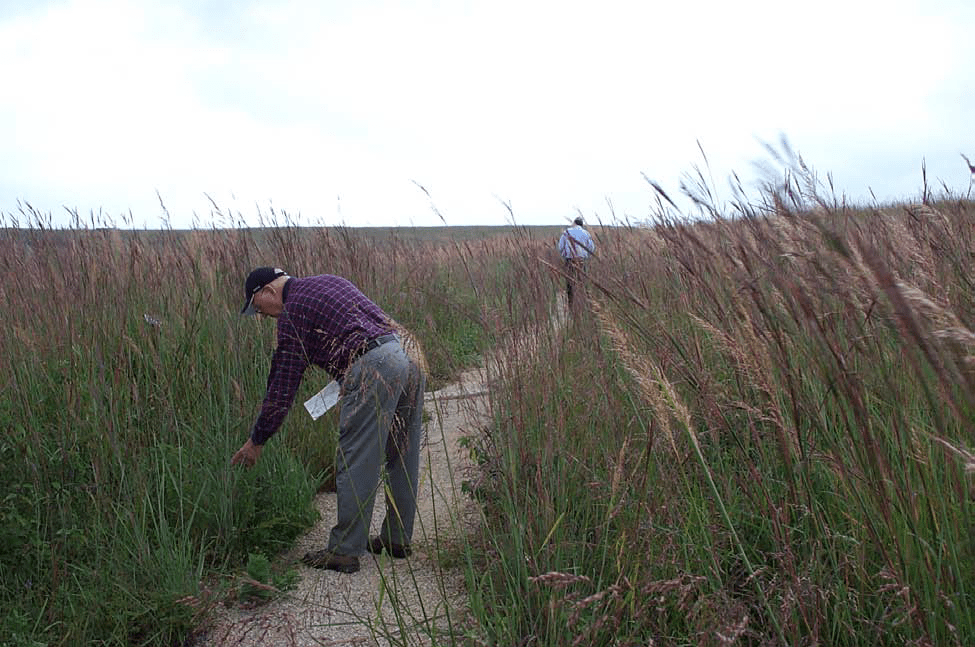
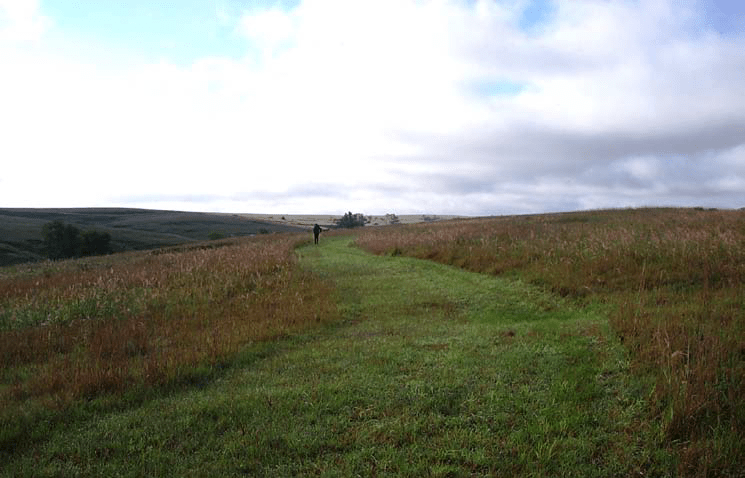
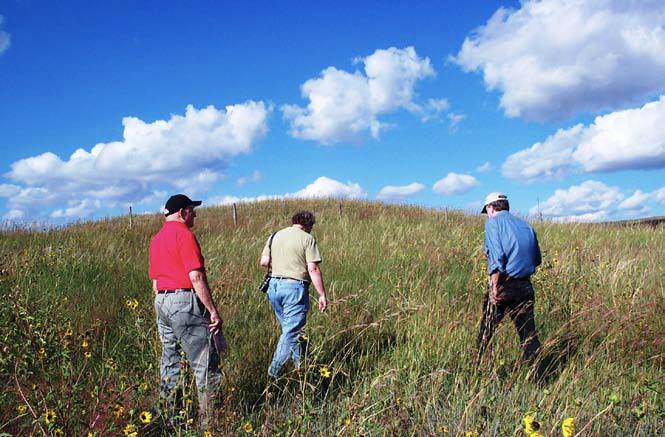
Our undesignated, but immensely effective, leader can be seen in the distance of this lovely site
Unidentified species included:
Legumes, Forbs, Shrubs, Trees
Eupatoriadelphus fistulosus (Barratt) King & H. Rob. Trumpetweed (Joe-Pye weed)
Euphorbia marginata Pursh snow on the mountain
Juniperus virginiana L. eastern redcedar
Oligoneuron rigidum (L.) Small var. glabratum (E.L. Braun) G.L. Nesom
stiff goldenrod
Rhus typhina L. staghorn sumac
Salvia azurea Michx. ex Lam. var. grandiflora Benth. pitcher sage
Stenosiphon linifolius (Nutt. ex James) Heynh false gaura
Symphoricarpos albus (L.) S.F. Blake common snowberry
Unidentified species included:
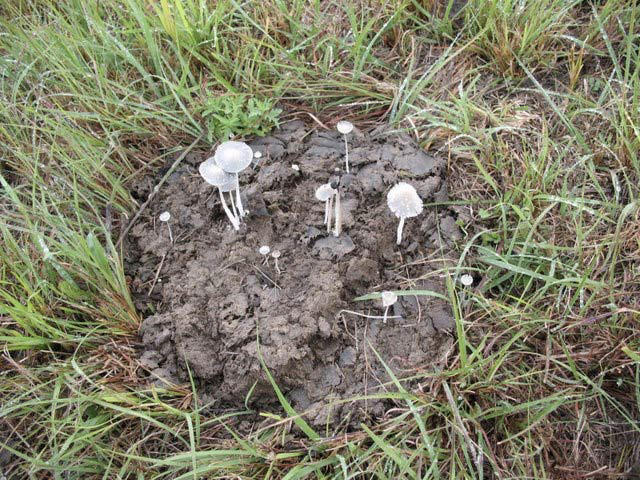
blooming cow pies …mama and baby blooms …the whole family
Following a pleasant detour to a Red Cloud book store, we were off to the Sand Hill of Nebraska.
Day 5, Observational Site 10 – Samuel R. McKelvie National Forest
Not far into the Sand Hills we made our first observational site at the Samuel R. McKelvie National Forest. There it was, completely hand planted, competing for our beloved native grass.
:The survival of this forest is questionable without on-going human intervention.
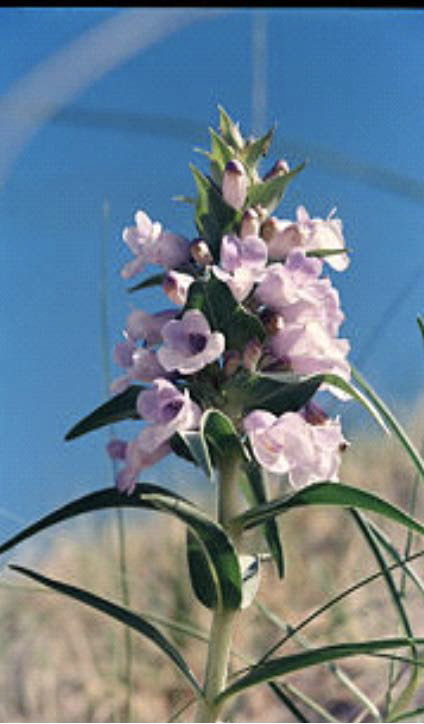
While we did not see it, blowout penstemon (Penstemon haydenii),
the rarest plant species native to the Great Plains, which grows only in the Sandhills, can be found in the forest.
Other plants observed at the site include:
Andropogon gerardii Vitman big bluestem
Calamovilfa longifolia (Hook.) Scribn. prairie sandreed
Eriogonum annuum Nutt. annual buckwheat
Oenothera biennis L. common evening
primrose
Panicum virgatum L. switchgrass
Schizachyrium scoparium (Michx.) Nash little bluestem
Sorghastrum nutans (L.) Nash Indiangrass
Trees used to establish the forest were:
Juniperus virginiana L. eastern redcedar
Pinus banksiana Lamb. jack pine
Pinus ponderosa C. Lawson ponderosa pine
Pinus sylvestris L. Scots pine
Day 5, Observational Site 11 – Valentine National Wildlife Refuge
Leaving the Samuel R. McKelvie National Forest, we traveled north on highway US 83 to the Valentine Wildlife Refuge is south of the city of Valentine, Nebraska. Although it was Saturday, and no employees were on site, it was available for our botanizing. We found a rich flora of:
Grasses
Agrostis stolonifera L. creeping bentgrass
Andropogon gerardii Vitman big bluestem
Andropogon hallii Hack. sand bluestem
Bouteloua curtipendula (Michx.) Torr. sideoats grama
Calamovilfa longifolia (Hook.) Scribn. prairie sandreed
Eragrostis trichodes (Nutt.) Alph. Wood sand lovegrass
Koeleria macrantha (Ledeb.) Schult. prairie junegrass
Muhlenbergia pungens Thurb. sandhill muhly
Panicum virgatum L. switchgrass
Paspalum setaceum Michx. thin paspalum
Schizachyrium scoparium (Michx.) Nash little bluestem
Sorghastrum nutans (L.) Nash Indiangrass
Sporobolus heterolepis (A. Gray) A. Gray prairie dropseed
Five or six foot bluestem in the Sandhills is impressive
Grass-like, Legume, Forb, Shrub
Amorpha canescens Pursh leadplant
Apocynum cannabinum L. Indianhemp
Artemisia campestris L. field sagewort
Artemisia filifolia Torr. sand sagebrush
Carex L. (three possible species, C. duriscula, C. filifolia, C. inops)
sedge:
The survival of this forest is questionable without on-going human intervention.
Day 5, Observational Site 11 – Valentine National Wildlife Refuge
Leaving the Samuel R. McKelvie National Forest, we traveled north on highway US 83 to the Valentine Wildlife Refuge is south of the city of Valentine, Nebraska. Although it was Saturday, and no employees were on site, it was available for our botanizing. We found a rich flora of:
Grasses
Agrostis stolonifera L. creeping bentgrass
Andropogon gerardii Vitman big bluestem
Andropogon hallii Hack. sand bluestem
Bouteloua curtipendula (Michx.) Torr. sideoats grama
Calamovilfa longifolia (Hook.) Scribn. prairie sandreed
Eragrostis trichodes (Nutt.) Alph. Wood sand lovegrass
Koeleria macrantha (Ledeb.) Schult. prairie junegrass
Muhlenbergia pungens Thurb. sandhill muhly
Panicum virgatum L. switchgrass
Paspalum setaceum Michx. thin paspalum
Schizachyrium scoparium (Michx.) Nash little bluestem
Sorghastrum nutans (L.) Nash Indiangrass
Sporobolus heterolepis (A. Gray) A. Gray prairie dropseed
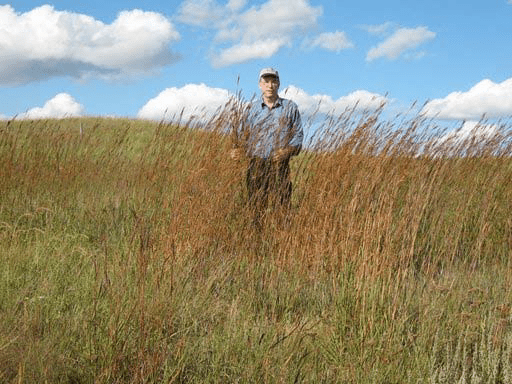
Five or six foot bluestem in the Sandhills is impressive
Grass-like, Legume, Forb, Shrub
Amorpha canescens Pursh leadplant
Apocynum cannabinum L. Indianhemp
Artemisia campestris L. field sagewort
Artemisia filifolia Torr. sand sagebrush
Carex L. (three possible species, C. duriscula, C. filifolia, C. inops)
sedge
Cycloloma atriplicifolium (Spreng.) J.M. Coult. winged pigweed
Glycyrrhiza lepidota Pursh American licorice
Ipomopsis longiflora (Torr.) V.E. Grant ssp. longiflora flaxflowered ipomopsis
Prunus pumila L. sandcherry
Solidago missouriensis Nutt. Missouri goldenrod
Symphoricarpos albus (L.) S.F. Blake common snowberry
Symphyotrichum ericoides (L.) G.L. Nesom white heath aster
to and sweep of the area by calling its number soon returned the lost berry.
Following the recovery we retired in the community of Valentine, NB for the evening.
Day 6, Observational Site 12 – Fort Niobrara National Wildlife Refuge.
On our drive through the Refuge on the morning of September 13, we found many old fiends,
including:
Grass
Andropogon gerardii Vitman big bluestem
Andropogon hallii Hack. sand bluestem
Bouteloua curtipendula (Michx.) Torr. sideoats grama
Bouteloua dactyloides (Nutt.) J.T. Columbus buffalograss
Bouteloua gracilis (Willd. ex Kunth) Lag. ex Griffiths blue grama
Elymus canadensis L. Canada wildrye
Hesperostipa comata (Trin. & Rupr.) Barkworth needle and thread
Panicum virgatum L. switchgrass
Pascopyrum smithii (Rydb.) A. Löve western wheatgrass
Schizachyrium scoparium (Michx.) Nash little bluestem
Sorghastrum nutans (L.) Nash Indiangrass
Spartina pectinata Bosc ex Link prairie cordgrass
Sporobolus heterolepis (A. Gray) A. Gray prairie dropseed
Tree
Pinus ponderosa C. Lawson ponderosa pine
Plus a few other interesting species.
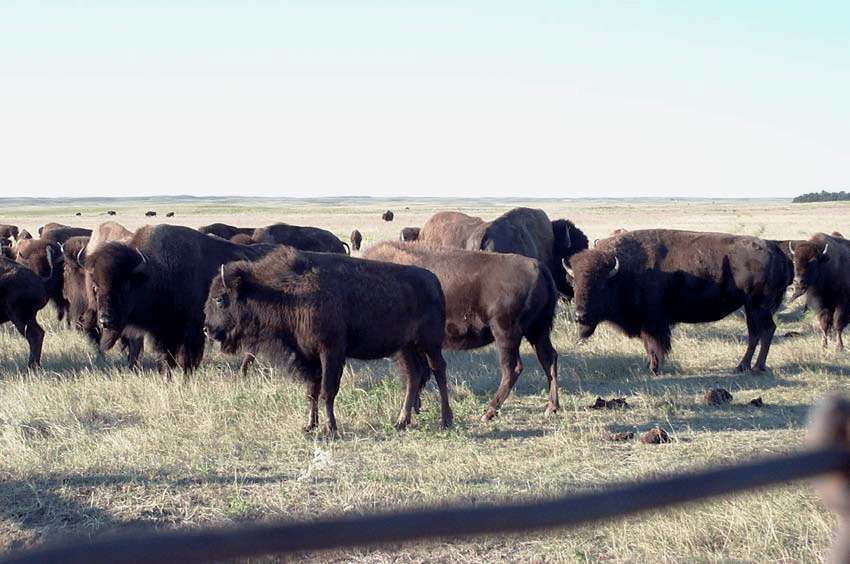
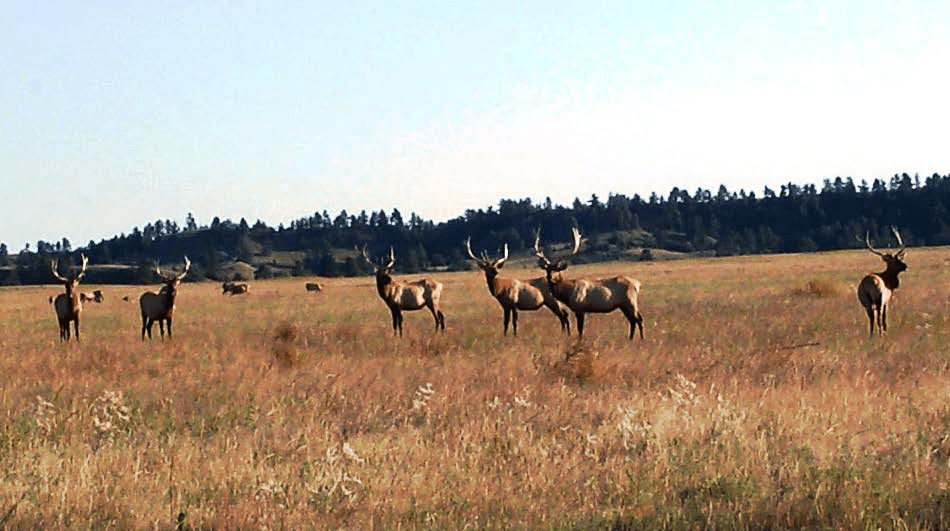
While the entire day could have been spent at the Fort Niobrara National Wildlife Refuge, there was
more sites to be seen, so we headed west on US 20, stopping first at a private ranch about 30 mile west of Valentine.
Day 6, Observational Site 13 – Route US 20 Private Ranch.

Excellent managed pasture, containing:
Grass
Andropogon hallii Hack. sand bluestem
Calamovilfa longifolia (Hook.) Scribn. prairie sandreed
Koeleria macrantha (Ledeb.) Schult. prairie Junegrass
Hesperostipa comata (Trin. & Rupr.) Barkworth needle and thread
Panicum virgatum L. switchgrass
Pascopyrum smithii (Rydb.) A. Löve western wheatgrass
(This was the dominate plant in the stand.)
Schizachyrium scoparium (Michx.) Nash little bluestem
Sorghastrum nutans (L.) Nash Indiangrass
Legume, Forb, Shrub
Artemisia ludoviciana Nutt. white sagebrush
Helianthus annuus L. common sunflower
Psoralidium tenuiflorum (Pursh) Rydb. slimflower scurfpea
 Conservation Plants
Leave a comment