
For the Love of Grass VI

The sixth botanizing trek for the “Love of Grass” enjoyed a special rendezvous location, assembling at the home of trek participant Robert MacLauchlan in Lincoln, Nebraska. By five o’clock in the afternoon on August 17, 2013 the six members from the 2012 trek were enjoying fellowship and a cookout provided by Bob’s daughter and son-in-law Nancy and Andy Bess. Bob is blessed with children close by.


The sixth trek was originally scheduled for a spring sojourn through the foothills of California. Scheduling difficulties led to this later agenda, put together by Jack Carlson. He and plant identifying wizard Larry Holzworth constituted the botanizing power, with Wendall Oaks and Wendell Hassell in major support roles, and added photographic responsibilities. Curtis Sharp and Bob rounded out the team, supplying wisdom and good looks, of questionable botanizing value but useful at the Prairie Chick in Okobogi, Iowa.
Our inventory mission was the same as previous treks, at each site to identify every plant within a ‘reasonable’ area, consisting of one to several acres, and leave only when satisfied that this had been accomplished. Increasing skill levels, shorter distances between sites and motel reservations via cell phones resulted in slightly shorter workdays, much to the delight of the ancient ones, 83 and 85.
During the seven days of inventorying the team traveled 1,534 miles, inventoried 17 sites at 13 locations, and identified as many as 127 species at one site, correctly or incorrectly identified 1,083 plants of 312 species, saw three plus million acres of corn and soybeans, scheduled the 2014 trek, and four of the trekkers endured an epidemic of chigger bites. At least we had evidence for our spouses and significant others of the fun we had. Of the species we identified 39% occurred only once, 15% twice, 9% three times and 4 through 16 times 37%. The top 20 species occurring at the 17 inventory sites were:
| Scientific Name | Frequency |
| Bromus inermis Leyss (smooth brome) | 16 |
| Andropogon gerardii Vitman (big bluestem) | 15 |
| Amorpha canescens Pursh (leadplant) | 14 |
| Ascelpias syriaca L. (common milkweed) | 14 |
| Solidago altissima L. (Canada goldenrod) | 14 |
| Ambrosia psilostachya DC. (Cuman ragweed) | 13 |
| Artemisia ludoviciana Nutt. (white sagebrush) | 13 |
| Poa pratensis L. (Kentucky bluegrass) | 13 |
| Rosa arkansana Porter (prairie rose) | 13 |
| Schizachyrium scoparium (Michx.) Nash (little bluestem) | 13 |
| Echinacea angustifolia DC. (purple coneflower) | 12 |
| Oligoneuron rigidum (L.) Small (stiff goldenrod) | 12 |
| Panicum virgatum L. (switchgrass) | 12 |
| Bouteloua curtipendula (Michx.) Torr. (sideoats grama) | 11 |
| Dalea purpurea Vent. (purple prairieclover) | 11 |
| Liatris aspera Michx. (tall blazing star) | 11 |
| Spartina pectinata Bosc ex Link (prairie cordgrass) | 11 |
| Symphoricarpos occidentalis Hook. (western snowberry) | 11 |
| Artemisia campestris L. (field sagebrush) | 10 |
| Melilotus officinalis (L.) Lam. (yellow sweetclover) | 10 |
Species and common names were taken from PLANTS (http://plants.usda.gov). Most photographs were taken at the true site although the same species appeared at multiple sites.
Some members of the trek team were struck by the notion of having enjoyed their plant materials profession so much that they would tramp through endless prairies just is see what plants were there, concluding they were greatly blessed. The trek schedule of years to come supports this point of view. Proposed rendezvous for 2014 is Sacramento, California, on March 16, 2014. The objective is to find remnant perennial grasses in the annual grasslands surrounding the Central Valley.
During the cookout, Curtis Sharp provided the team with a pre-inventory he took at the hotel while waiting for the rest of the team to arrive that day. Hence the following:
Inventory Site 0 – Horizon Inn, Lancaster County, NE
| Scientific Name | Common Name | Type | Origin |
| Apocynum cannabinum L. | Indianhemp | Forb | Native |
| Ascelpias incarnata L. | swamp milkweed | Forb | Native |
| Bromus inermis Leyss. | smooth brome | Graminoid | Introduced |
| Cicuta maculata L. | spotted water hemlock | Forb | Native |
| Convolvulus arvensis L. | field bindweed | Forb | Introduced |
| Gaura parviflora Douglas ex Lehm. | velvetweed | Forb | Native |
| Morus alba L. | white mulberry | Tree | Introduced |
| Physalis virginiana Mill. | Virginia groundcherry | Forb | Native |
| Vernonia fasciculata Michx. | prairie ironweed | Forb | Native |
Day 1 – Sunday, August 18, 1913
By 8:30 AM bags were loaded, Bob Mac had been picked up and designated driver Oaks and navigator Carlson, with iPad in hand, headed for our first inventory site a short jaunt southwest of Lincoln. The air was clear, the traffic nil, the anticipation high.
Inventory Site 1 – Spring Creek Prairie and Audubon Center, Lancaster County, NE
Spring Creek Prairie Audubon Center is an 808-acre tallgrass prairie nature preserve located 20 minutes southwest of Lincoln. Nearly 650 acres have never been plowed. This area contains tallgrass prairie, ponds and wetlands, wildflowers and grasses, a diverse assortment of birds and other wildlife, peaceful surroundings, and beautiful scenic vistas. This was a perfect place to start our trek.


| Scientific Name | Common Name | Type | Origin |
| Abutilon theophrasti Medik | velvetleaf | Forb | Introduced |
| Ambrosia artemisiifolia L. | annual ragweed | Forb | Native |
| Ambrosia psilostachya DC. | Cuman ragweed | Forb | Native |
| Ambrosia trifida L. | great ragweed | Forb | Native |
| Amorpha canescens Pursh | leadplant | Legume | Native |
| Amorpha fruticosa L. | false indigo bush | Shrub | Native |
| Andropogon gerardii Vitman | big bluestem | Graminoid | Native |
| Artemisia campestris L. | field sagewort | Forb | Native |
| Artemisia ludoviciana Nutt. | white sagebrush | Forb | Native |
| Ascelpias incarnata L. | swamp milkweed | Forb | Native |
| Ascelpias syriaca L. | common milkweed | Forb | Native |
| Asclepias tuberosa L. | butterfly milkweed | Forb | Native |
| Asclepias verticillata L. | whorled milkweed | Forb | Native |
| Bouteloua curtipendula (Michx.) Torr. | sideoats grama | Graminoid | Native |
| Bouteloua dactyloides (Nutt.) J.T. Columbus | buffalograss | Graminoid | Native |
| Bouteloua gracilis (Willd. ex Kunth) Lag. ex Griffiths | blue grama | Graminoid | Native |
| Brickellia eupatorioides (L.) Shinners | false boneset | Forb | Native |
| Bromus arvensis L. | field brome | Graminoid | Introduced |
| Bromus inermis Leyss. | smooth brome | Graminoid | Introduced |
| Callirhoe involucrata (Torr. & A. Gray) A. Gray | purple poppymallow | Forb | Native |
| Celtis occidentalis | eastern hackberry | Tree | Native |
| Chamaecrista fasciculata (Michx.) Greene | partridge pea | Legume | Native |
| Chamaesyce nutans (Lag.) Small | eyebane | Forb | Native |
| Chenopodium standleyanum Aellen | Standley’s goosefoot | Forb | Native |
| Cirsium flodmanii (Rydb.) Arthur | Flodman’s thistle | Forb | Native |
| Cirsium undulatum (Nutt.) Spreng. | wavyleaf thistle | Forb | Native |
| Conium maculatum L. | poison hemlock | Forb | Introduced |
| Convolvulus arvensis L. | field bindweed | Forb | Introduced |
| Conyza canadensis (L.) Cronquist | Canadian horseweed | Forb | Native |
| Cornus drummondii C.A. Mey. | roughleaf dogwood | Shrub | Native |
| Cynodon dactylon (L.) Pers. | bermudagrass | Graminoid | Introduced |
| Dalea candida Michx. ex Willd. | white prairieclover | Legume | Native |
| Dalea purpurea Vent. | purple prairieclover | Legume | Native |
| Datura stramonium L. | jimsonweed | Forb | Introduced |
| Daucus carota L. | Queen Anne’s lace | Forb | Introduced |
| Desmodium illinoense A. Gray | Illinois ticktrefoil | Legume | Native |
| Digitaria sanguinalis (L.) Scop. | hairy crabgrass | Graminoid | Introduced |
| Echinacea angustifolia DC. | blacksamson echinacea | Forb | Native |
| Elymus canadensis L. | Canada wildrye | Graminoid | Native |
| Elymus repens (L.) Gould | quackgrass | Graminoid | Introduced |
| Equisetum laevigatum A. Braun | smooth horsestail | Forb | Native |
| Eragrostis spectabilis (Pursh) Steud. | purple lovegrass | Graminoid | Native |
| Erigeron strigosus Muhl. ex Willd. | prairie fleabane | Forb | Native |
| Euphorbia dentata Michx. | toothed spurge | Forb | Native |
| Euphorbia marginata Pursh | snow on the mountain | Forb | Native |
| Fraxinus pennsylvanica Marshall | green ash | Tree | Native |
| Gaura longiflora Spach | longflower beeblossom | Forb | Native |
| Gaura parviflora Douglas ex Lehm. | velvetweed | Forb | Native |
| Gleditsia triacanthos L. | honeylocust | Tree | Native |
| Glycyrrhiza lepidota Pursh | American licorice | Legume | Native |
| Grindelia squarrosa (Pursh) Dunal | curlycup gumweed | Forb | Native |
| Helianthus annuus L. | common sunflower | Forb | Native |
| Helianthus grosseserratus M. Martens | sawtooth sunflower | Forb | Native |
| Helianthus maximiliani Schrad. | Maximillian sunflower | Forb | Native |
| Helianthus pauciflorus Nutt. ssp. pauciflorus | stff sunflower | Forb | Native |
| Heliopsis helianthoides (L.) Sweet | smooth oxeye | Forb | Native |
| Juniperus virginiana L. | eastern redcedar | Tree | Native |
| Koeleria macrantha (Ledeb.) Schult. | prairie junegrass | Graminoid | Native |
| Lactuca serriola L. | prickly lettuce | Forb | Introduced |
| Lespedeza capitata Michx. | roundhead lespedeza | Legume | Native |
| Liatris punctata Hook. | dotted blazing star | Forb | Native |
| Liatris pycnostachya Michx. | prairie blazing star | Forb | Native |
| Linum sulcatum Riddell | grooved flax | Forb | Native |
| Lotus unifoliolatus (Hook.) Benth. var. unifoliolatus | American bird’s-foot trefoil | Legume | Native |
| Medicago sativa L. | alfalfa | Legume | Introduced |
| Monarda fistulosa L. | wild bergamot | Forb | Native |
| Morus alba L. | white mulberry | Tree | Introduced |
| Muhlenbergia schreberi J.F. Gmel. | nimblewill | Graminoid | Native |
| Oenothera biennis L. | common evening primrose | Forb | Native |
| Oligoneuron rigidum (L.) Small | stiff goldenrod | Forb | Native |
| Pancium capillare L. | witchgrass | Graminoid | Native |
| Panicum virgatum L. | switchgrass | Graminoid | Native |
| Pascopyrum smithii (Rydb.) Á. Löve | western wheatgrass | Graminoid | Native |
| Pediomelum argophyllum (Pursh) J. Grimes | silverleaf Indian breadroot | Legume | Native |
| Phalaris arundinacea L. | reed canarygrass | Graminoid | Native |
| Physalis virginiana Mill. | Virginia groundcherry | Forb | Native |
| Phytolacca americana L. | American pokeweed | Forb | Native |
| Plantago major L. | common plantain | Forb | Introduced |
| Poa pratensis L. | Kentucky bluegrass | Graminoid | Native |
| Polygonum arenastrum Jord. ex Boreau | oval-leaf knotweed | Forb | Introduced |
| Populus deltoides W. Bartram ex Marshall ssp. monilifera | plains cottonwood | Tree | Native |
| Prunus americana Marshall | American plum | Shrub | Native |
| Ratibida columnifera (Nutt.) Woot. & Standl. | upright prairie coneflower | Forb | Native |
| Rhus glabra L. | smooth sumac | Shrub | Native |
| Rosa arkansana Porter | prairie rose | Shrub | Native |
| Rudbeckia hirta L. | blackeyed Susan | Forb | Native |
| Sagittaria calycina Engelm. | hooded arrowhead | Forb | Native |
| Salsola tragus L. | prickly Russian thistle | Forb | Introduced |
| Salvia azurea Michx. ex Lam. | azure blue sage | Forb | Native |
| Sambucus nigra L. ssp. canadensis (L.) R. Bolli | American black elderberry | Shrub | Native |
| Schizachyrium scoparium (Michx.) Nash | little bluestem | Graminoid | Native |
| Setaria viridis (L.) P. Beauv. | green bristlegrass | Graminoid | Introduced |
| Silphium integrifolium Michx. | wholeleaf rosinweed | Forb | Native |
| Silphium laciniatum L. | compassplant | Forb | Native |
| Sisymbrium loeselii L. | small tumbleweed mustard | Forb | Introduced |
| Solanum rostratum Dunal | buffalobur nightshade | Forb | Native |
| Solidago altissima L. | Canada goldenrod | Forb | Native |
| Solidago missouriensis Nutt. | Missouri goldenrod | Forb | Native |
| Sonchus arvensis L. | field sowthistle | Forb | Introduced |
| Sonchus asper (L.) Hill | spiny sowthistle | Forb | Introduced |
| Sorghastrum nutans (L.) Nash | Indiangrass | Graminoid | Native |
| Sporobolus heterolepis (A. Gray) A. Gray | prairie dropseed | Graminoid | Native |
| Symphoricarpos orbiculatus Moench | coralberry | Shrub | Native |
| Taraxacum officinale F.H. Wigg. | common dandelion | Forb | Introduced |
| Tragopogon dubius Scop. | yellow salsify | Forb | Introduced |
| Tribulus terrestris L. | puncturevine | Forb | Introduced |
| Trifolium pratense L. | red clover | Legume | Introduced |
| Typha angustifolia L. | narrowleaf cattail | Forb | Native |
| Ulmus pumila L. | Siberian elm | Tree | Introduced |
| Ulmus rubra Muhl. | slippery elm | Tree | Native |
| Verbena hastata L. | swamp verbena | Forb | Native |
| Vernonia baldwinii Torr. | Baldwin’s ironweed | Forb | Native |
| Vitis riparia Michx. | riverbank grape | Vine | Native |
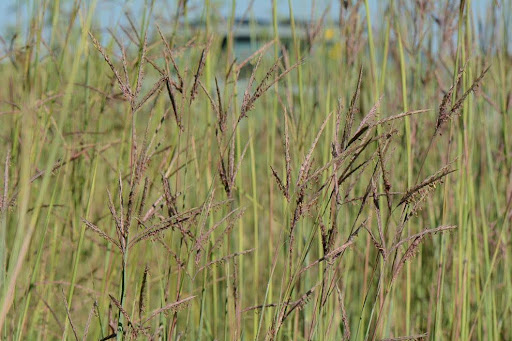
One common grass at this and most sites is “king of native grasses,” big bluestem. It was the main constituent of prairie hay. The Chippewa used big bluestem as medicine for indigestion and stomach pains. The Omaha made a decoction of the the leaf blades to treat general debility from an unknown cause. For fevers, a cut was made on the top of the head and bathed with this decoction. If a fever developed from a wound, lower leaves were applied directly to the wound. The Omaha-Ponca name for big bluestem was hade-zhide, meaning “red hay.” Early settlers found that corn grew best where “big blue” grew. Most of the corn land of the Corn Belt once supported stands of big bluestem.
Pictures of plants found at Site 1:


The team identified 112 species of the 348 on their plant list, and also found a few not on the checklist, for example Salsola tragus. The trekkers departed for lunch at the Denton Daily Double, and after deliberation returned to the Spring Creek visitor’s center, which had opened by then, where a plant list and even more books were added to the traveling library.

A note on why the team did not find all 348 species at Spring Creek. The late summer/fall species had asserted themselves, “hiding” most spring and early summer species, and the site was considerably larger than the area sampled. The group felt confident the plants of the day had introduced themselves, reinforcing the desirability of visiting these prairies often throughout the season. If not just to clear the mind.
Inventory Site 2 – Nine-Mile Prairie, University of Nebraska, Lancaster County, NE
This site is owned by University of Nebraska Foundation (purchased in 1983) and leased to the University of Nebraska. Nine-Mile Prairie is a 230-acre relict tallgrass prairie. The prairie was so named because it is five miles west and four miles north of the University campus in downtown Lincoln. Previous botanists have identified 392 vascular plant species. Management consists of springtime burning on a 3-year fire-return interval, along with periodic haying and weed/brush control using herbicides. The prairie has not been grazed since 1968. it serves as a nationally important outdoor laboratory for the study of biological processes in grasslands.

Nine-Mile is the longest-studied natural area in Nebraska, serving as the site of pioneering research in plant ecology by Professor John E. Weaver, a reputed father of grassland ecology. The team observed side by side comparison of impacts of burning on reducing the smooth brome component of the prairie. It is somewhat ironic that smooth brome came to the California Experiment Station in 1884, its promise as a pasture species resulting in seed packets sent to stations in most other states, where it certainly has found a home in the Great Plains. The team was to have their fill of corn, soybeans, smooth brome, and wind turbines the rest of the week.
| Scientific Name | Common Name | Type | Origin |
| Achillea millefolium L. | common yarrow | Forb | Native |
| Agrostis gigantea Roth | redtop | Graminoid | Introduced |
| Ambrosia psilostachya DC. | Cuman ragweed | Forb | Native |
| Amorpha canescens Pursh | leadplant | Legume | Native |
| Andropogon gerardii Vitman | big bluestem | Graminoid | Native |
| Artemisia campestris L. | field sagewort | Forb | Native |
| Artemisia ludoviciana Nutt. | white sagebrush | Forb | Native |
| Ascelpias syriaca L. | common milkweed | Forb | Native |
| Bouteloua curtipendula (Michx.) Torr. | sideoats grama | Graminoid | Native |
| Brickellia eupatorioides (L.) Shinners | false boneset | Forb | Native |
| Bromus inermis Leyss. | smooth brome | Graminoid | Introduced |
| Callirhoe involucrata (Torr. & A. Gray) A. Gray | purple poppymallow | Forb | Native |
| Carex inops L.H. Bailey ssp. heliophila | sun sedge | Graminoid | Native |
| Celtis occidentalis | eastern hackberry | Tree | Native |
| Chloris verticillata Nutt. | tumble windmill grass | Graminoid | Native |
| Cirsium altissimum (L.) Hill | tall thistle | Forb | Native |
| Convolvulus arvensis L. | field bindweed | Forb | Introduced |
| Conyza canadensis (L.) Cronquist | Canadian horseweed | Forb | Native |
| Cornus drummondii C.A. Mey. | roughleaf dogwood | Shrub | Native |
| Dalea candida Michx. ex Willd. | white prairieclover | Legume | Native |
| Dalea purpurea Vent. | purple prairieclover | Legume | Native |
| Desmodium illinoense A. Gray | Illinois ticktrefoil | Legume | Native |
| Dianthus armeria L. | Deptford pink | Forb | Introduced |
| Eragrostis spectabilis (Pursh) Steud. | purple lovegrass | Graminoid | Native |
| Erigeron strigosus Muhl. ex Willd. | prairie fleabane | Forb | Native |
| Euphorbia dentata Michx. | toothed spurge | Forb | Native |
| Euphorbia marginata Pursh | snow on the mountain | Forb | Native |
| Gaura parviflora Douglas ex Lehm. | velvetweed | Forb | Native |
| Helianthus grosseserratus M. Martens | sawtooth sunflower | Forb | Native |
| Helianthus maximiliani Schrad. | Maximillian sunflower | Forb | Native |
| Helianthus pauciflorus Nutt. ssp. pauciflorus | stff sunflower | Forb | Native |
| Heliopsis helianthoides (L.) Sweet | smooth oxeye | Forb | Native |
| Koeleria macrantha (Ledeb.) Schult. | prairie junegrass | Graminoid | Native |
| Lactuca serriola L. | prickly lettuce | Forb | Introduced |
| Lespedeza capitata Michx. | roundhead lespedeza | Legume | Native |
| Liatris aspera Michx. | tall blazing star | Forb | Native |
| Medicago sativa L. | alfalfa | Legume | Introduced |
| Melilotus officinalis (L.) Lam. | yellow sweetclover | Legume | Introduced |
| Oligoneuron rigidum (L.) Small | stiff goldenrod | Forb | Native |
| Panicum virgatum L. | switchgrass | Graminoid | Native |
| Pediomelum argophyllum (Pursh) J. Grimes | silverleaf Indian breadroot | Legume | Native |
| Physalis longifolia Nutt. | longleaf groundcherry | Forb | Native |
| Poa pratensis L. | Kentucky bluegrass | Graminoid | Native |
| Psoralidium lanceolatum (Pursh) Rydb. | lemon scurfpea | Legume | Native |
| Psoralidium tenuiflorum (Pursh) Rydb. | slimflower scurfpea | Legume | Native |
| Rhus glabra L. | smooth sumac | Shrub | Native |
| Rosa arkansana Porter | prairie rose | Shrub | Native |
| Salvia azurea Michx. ex Lam. | azure blue sage | Forb | Native |
| Schizachyrium scoparium (Michx.) Nash | little bluestem | Graminoid | Native |
| Solidago altissima L. | Canada goldenrod | Forb | Native |
| Sorghastrum nutans (L.) Nash | Indiangrass | Graminoid | Native |
| Sporobolus compositus (Poir.) Merr. | composite dropseed | Graminoid | Native |
| Sporobolus heterolepis (A. Gray) A. Gray | prairie dropseed | Graminoid | Native |
| Symphoricarpos occidentalis Hook. | western snowberry | Shrub | Native |
| Trifolium pratense L. | red clover | Legume | Introduced |
| Vernonia baldwinii Torr. | Baldwin’s ironweed | Forb | Native |
Pictures of plants found at Site 2:


Having identified and recorded 179 plants on our first day out, we headed north through the corn and soybeans of eastern Nebraska for Sioux City, Iowa, stopping in Wahoo for ice cream. As Oaks drove on he lobbied with multiple motels at our destination for the best rate, constantly being encouraged to do better by his fellow travelers. The results were satisfactory.
Day 2 – Monday, August 19, 1913
Departing at 8:00 am, Carlson guided us northeast from Sioux City, Iowa into Plymouth County for the Nature Conservancy’s Broken Kettle Grasslands Preserve. Part of the in-car conversation that morning concerned the red spots and itching on Sharp’s soon-to-be not so private areas. The diagnosis was chiggers. Sympathy abounded with comments like “You got ‘em, you keep ‘em”. That attitude was short-lived.
Inventory Site 3 – Broken Kettle Grasslands Preserve, Plymouth County, IA
Broken Kettle remains a sweeping reminder of nature’s beauty. Not only is it the Nature Conservancy’s largest preserve in Iowa but also it contains the largest remaining prairie in Iowa. In 1999, the Conservancy found the prairie rattlesnake, an extremely rare species, at this site, making Broken Kettle even more important to the region. The Nature Conservancy welcomed a herd of 28 bison at Broken Kettle Grasslands preserve in the fall of 2008. Broken Kettle Grasslands forms the core of the protection efforts in the northern portion of the Loess Hills and is a stellar example of this rare landform. Iowa’s Loess Hills were literally blown into existence as the glaciers from the last Ice Age retreated. The extent and depth of the loess deposits along Iowa’s western border are matched only in China.
Upon arrival at the preserve Carlson conversed with staff at the office and was told they had just released a crop, hatch, herd or whatever, of western rattlesnakes and we might want to avoid the hills immediately bordering the Missouri River flood plain. That seemed reasonable, so Jack led east into the hills, which may well have been the most fruitful and attractive prairie of the entire trek. Smooth brome greeting us at the entrance was a little deceptive, walking up the slope at a good pace we quickly went to work.


| Scientific Name | Common Name | Type | Origin |
| Acer negundo L. | boxelder | Tree | Native |
| Agalinis aspera (Douglas ex Benth.) Britton | false tall foxglove | Forb | Native |
| Ambrosia psilostachya DC. | Cuman ragweed | Forb | Native |
| Amorpha canescens Pursh | leadplant | Legume | Native |
| Andropogon gerardii Vitman | big bluestem | Graminoid | Native |
| Anemone cylindrica A. Gray | candle anemone | Forb | Native |
| Artemisia campestris L. | field sagewort | Forb | Native |
| Ascelpias syriaca L. | common milkweed | Forb | Native |
| Bouteloua curtipendula (Michx.) Torr. | sideoats grama | Graminoid | Native |
| Bromus inermis Leyss. | smooth brome | Graminoid | Introduced |
| Cannabis sativa L. | marijuana | Forb | Introduced |
| Celtis occidentalis | eastern hackberry | Tree | Native |
| Chamaecrista fasciculata (Michx.) Greene | partridge pea | Legume | Native |
| Chamaesyce glyptosperma (Engelm.) Small | ribseed sandmat | Forb | Native |
| Cirsium flodmanii (Rydb.) Arthur | Flodman’s thistle | Forb | Native |
| Comandra umbellata (L.) Nutt. | bastard toadflax | Forb | Native |
| Conyza canadensis (L.) Cronquist | Canadian horseweed | Forb | Native |
| Cornus drummondii C.A. Mey. | roughleaf dogwood | Shrub | Native |
| Dalea candida Michx. ex Willd. | white prairieclover | Legume | Native |
| Dalea enneandra Nutt. | nineanther prairie clover | Legume | Native |
| Dalea purpurea Vent. | purple prairieclover | Legume | Native |
| Echinacea angustifolia DC. | blacksamson echinacea | Forb | Native |
| Elymus canadensis L. | Canada wildrye | Graminoid | Native |
| Equisetum laevigatum A. Braun | smooth horsestail | Forb | Native |
| Erigeron strigosus Muhl. ex Willd. | prairie fleabane | Forb | Native |
| Euphorbia esula L. | leafy spurge | Forb | Introduced |
| Euphorbia marginata Pursh | snow on the mountain | Forb | Native |
| Fraxinus pennsylvanica Marshall | green ash | Tree | Native |
| Helianthus annuus L. | common sunflower | Forb | Native |
| Helianthus pauciflorus Nutt. ssp. pauciflorus | stff sunflower | Forb | Native |
| Heliopsis helianthoides (L.) Sweet | smooth oxeye | Forb | Native |
| Juglans nigra L. | black walnut | Tree | Native |
| Juniperus virginiana L. | eastern redcedar | Tree | Native |
| Koeleria macrantha (Ledeb.) Schult. | prairie junegrass | Graminoid | Native |
| Lactuca tatarica (L.) C.A. Mey. | blue lettuce | Forb | Native |
| Liatris aspera Michx. | tall blazing star | Forb | Native |
| Liatris punctata Hook. | dotted blazing star | Forb | Native |
| Linum sulcatum Riddell | grooved flax | Forb | Native |
| Lygodesmia juncea (Pursh) D. Don ex Hook. | rush skeletonplant | Forb | Native |
| Machaeranthera pinnatifida (Hook.) Shinners | lacy tansyaster | Forb | Native |
| Melilotus officinalis (L.) Lam. | yellow sweetclover | Legume | Introduced |
| Melilotus officinalis (L.) Lam. (alba) | white sweetclover | Legume | Introduced |
| Muhlenbergia cuspidata (Torr. ex Hook.) Rydb. | plains muhly | Graminoid | Native |
| Oligoneuron rigidum (L.) Small | stiff goldenrod | Forb | Native |
| Oxytropis lambertii Pursh | purple locoweed | Legume | Native |
| Pancium capillare L. | witchgrass | Graminoid | Native |
| Panicum virgatum L. | switchgrass | Graminoid | Native |
| Pediomelum argophyllum (Pursh) J. Grimes | silverleaf Indian breadroot | Legume | Native |
| Penstemon grandiflorus Nutt. | large beardtongue | Forb | Native |
| Poa palustris L. | fowl bluegrass | Graminoid | Native |
| Poa pratensis L. | Kentucky bluegrass | Graminoid | Native |
| Populus deltoides W. Bartram ex Marshall ssp. monilifera | plains cottonwood | Tree | Native |
| Prunus americana Marshall | American plum | Shrub | Native |
| Rhus glabra L. | smooth sumac | Shrub | Native |
| Rosa arkansana Porter | prairie rose | Shrub | Native |
| Schizachyrium scoparium (Michx.) Nash | little bluestem | Graminoid | Native |
| Securigera varia (L.) Lassen | crownvetch | Legume | Introduced |
| Setaria viridis (L.) P. Beauv. | green bristlegrass | Graminoid | Introduced |
| Solidago altissima L. | Canada goldenrod | Forb | Native |
| Solidago speciosa Nutt. | showy goldenrod | Forb | Native |
| Sorghastrum nutans (L.) Nash | Indiangrass | Graminoid | Native |
| Spartina pectinata Bosc ex Link | prairie cordgrass | Graminoid | Native |
| Symphoricarpos occidentalis Hook. | western snowberry | Shrub | Native |
| Verbena hastata L. | swamp verbena | Forb | Native |
| Vitis riparia Michx. | riverbank grape | Vine | Native |
Lead plant (Amorphia canescens) was found at most sites, including Broken Kettle Grasslands. The Oglala and other American Indians used the dried leaves for smoking and making tea. The tea was also used as a treatment for pinworms. Leaves were steeped and and the liquid was used to wash and treat eczema. The Omaha used a paste made from lead plant for rheumatism and neuralgia. Trek members chewed the leaves in hopes it would ease the chigger bit itching, but it didn’t.


Pictures of plants found at Site 3:


After an enjoyable morning and lunch at Bev’s by the (Missouri) River in Sioux City, our next site was right in town.
Inventory Site 4 – Center for Prairie Studies, Briar Cliff University, Sioux City, IA
This 150-acre Nature Conservancy preserve protects the nation’s largest urban tallgrass prairie. Located directly west of campus, it offers Briar Cliff students a noteworthy outdoor classroom. With that in mind, Briar Cliff established the Center for Prairie Studies in 2009, thanks to a major grant from the Gilchrist Foundation. The Center has received additional support from individuals, the Woodbury County Conservation Foundation, the Loess Hills Audubon Society, and the Loess Hills Alliance. The Center provides leadership regarding Briar Cliff’s goal to educate, acquire and respect a sense of place from the prairies of Iowa’s Loess Hills to the global arena.
This site is in the process or reverting to prairie species through management, and Carlson recorded just 50 species. The site gave the team the first glimpse of fire on the mountain, a miniature of its more famous cousin the Christmas poinsettia. Here it was, hidden down in the robust surrounding vegetation, but not likely to escape the photo lens of Oaks. We quickly went to work.


| Scientific Name | Common Name | Type | Origin |
| Ambrosia psilostachya DC. | Cuman ragweed | Forb | Native |
| Amorpha canescens Pursh | leadplant | Legume | Native |
| Andropogon gerardii Vitman | big bluestem | Graminoid | Native |
| Artemisia campestris L. | field sagewort | Forb | Native |
| Artemisia dracunculus L. | tarragon | Forb | Native |
| Artemisia ludoviciana Nutt. | white sagebrush | Forb | Native |
| Asclepias verticillata L. | whorled milkweed | Forb | Native |
| Bouteloua curtipendula (Michx.) Torr. | sideoats grama | Graminoid | Native |
| Bromus inermis Leyss. | smooth brome | Graminoid | Introduced |
| Calamovilfa longifolia (Hook.) Scribn. | prairie sandreed | Graminoid | Native |
| Cannabis sativa L. | marijuana | Forb | Introduced |
| Celtis occidentalis | eastern hackberry | Tree | Native |
| Comandra umbellata (L.) Nutt. | bastard toadflax | Forb | Native |
| Cornus drummondii C.A. Mey. | roughleaf dogwood | Shrub | Native |
| Dalea candida Michx. ex Willd. | white prairieclover | Legume | Native |
| Echinacea angustifolia DC. | blacksamson echinacea | Forb | Native |
| Elymus canadensis L. | Canada wildrye | Graminoid | Native |
| Eragrostis spectabilis (Pursh) Steud. | purple lovegrass | Graminoid | Native |
| Euphorbia cyathophora Murray | fire on the mountain | Forb | Native |
| Euphorbia esula L. | leafy spurge | Forb | Introduced |
| Euphorbia marginata Pursh | snow on the mountain | Forb | Native |
| Fraxinus pennsylvanica Marshall | green ash | Tree | Native |
| Helianthus pauciflorus Nutt. ssp. pauciflorus | stiff sunflower | Forb | Native |
| Heliopsis helianthoides (L.) Sweet | smooth oxeye | Forb | Native |
| Juglans nigra L. | black walnut | Tree | Native |
| Juniperus virginiana L. | eastern redcedar | Tree | Native |
| Liatris aspera Michx. | tall blazing star | Forb | Native |
| Lonicera tatarica L. | Tatarian honeysuckle | Shrub | Introduced |
| Lygodesmia juncea (Pursh) D. Don ex Hook. | rush skeletonplant | Forb | Native |
| Machaeranthera pinnatifida (Hook.) Shinners | lacy tansyaster | Forb | Native |
| Medicago lupulina L. | black medick | Legume | Introduced |
| Melilotus officinalis (L.) Lam. | yellow sweetclover | Legume | Introduced |
| Melilotus officinalis (L.) Lam. (alba) | white sweetclover | Legume | Introduced |
| Muhlenbergia cuspidata (Torr. ex Hook.) Rydb. | plains muhly | Graminoid | Native |
| Nassella viridula (Trin.) Barkworth | green needlegrass | Graminoid | Native |
| Oligoneuron rigidum (L.) Small | stiff goldenrod | Forb | Native |
| Onosmodium bejariense DC. ex A. DC. | soft-hair marbleseed | Forb | Native |
| Poa pratensis L. | Kentucky bluegrass | Graminoid | Native |
| Polygonum arenastrum Jord. ex Boreau | oval-leaf knotweed | Forb | Introduced |
| Ratibida columnifera (Nutt.) Woot. & Standl. | upright prairie coneflower | Forb | Native |
| Rhus glabra L. | smooth sumac | Shrub | Native |
| Schizachyrium scoparium (Michx.) Nash | little bluestem | Graminoid | Native |
| Solidago altissima L. | Canada goldenrod | Forb | Native |
| Solidago speciosa Nutt. | showy goldenrod | Forb | Native |
| Spartina pectinata Bosc ex Link | prairie cordgrass | Graminoid | Native |
| Sporobolus compositus (Poir.) Merr. | composite dropseed | Graminoid | Native |
| Sporobolus heterolepis (A. Gray) A. Gray | prairie dropseed | Graminoid | Native |
| Symphoricarpos occidentalis Hook. | western snowberry | Shrub | Native |
| Verbena hastata L. | swamp verbena | Forb | Native |
The lovely fire on the mountain (Euphorbia cyathophora) (Figure 4-3) is a member of the spurge family. Most members of the family are poisonous. The non-chigger inflicted trek trek members suggested chewing this plant as a cure.


The team experienced a special treat leaving the site, a group photo taken by the practicing university cheerleader squad.
On the road continuing north on I-29, Oaks exited and proceeded west to the east side of the Missouri a few miles to our next, for a non-inventory site.


Adams Homestead and Natural Preserve, Clay County, SD
This stop was more of an educational site, located just north of Sioux City, but in South Dakota. The property contains 1,500 acres along the Missouri River, and was donated to the people of South Dakota in 1984 by Mary and Maud Adams, granddaughters of original homesteader Stephen Searl Adams. They envisioned the area as a place where people, particularly youth, could enjoy the land and learn more about the natural world surrounding them. The site features miles of trails that wind through prairie, forest and along the riverbank.
With over 100 species of birds, a variety of native plants and a number of different animals, visitors are immersed in nature. Several pioneer period buildings had been mover to the site for preservation. One, a church, had been moved from near the town of Platte, more than 100 miles away and birthplace of Jack’s mother.


A relaxing stop, and from there the team drove through Sioux Falls and Brookings to Watertown, South Dakota for relatively uneventful evening, except for the discovery of additional infestations of chiggers affecting other members of the team. The evening meal was taken at Dempsey’s brew pub.
Day 3 – Tuesday, August 20, 1913
Inventory Site 5 – Waubay National Wildlife Refuge, Day County, SD
Waubay National Wildlife Refuge, located in northeastern South Dakota a short drive north from Watertown, was established in 1935 as a refuge and breeding ground for migratory birds and other wildlife. “Waubay,” means “a place where numbers of birds make their nests” in the Dakota language. The Refuge encompasses 4,650 acres of wetlands, native tallgrass prairie, and bur oak forest that provide a wide variety of nesting habitat for more than 100 species of waterfowl, song birds, and upland game birds. Water levels in prairie lakes, like Waubay Lake, are subject to extreme fluctuations. In the 1930’s, Waubay Lake was dry. Heavy precipitation between 1993 and 1997 caused the lake level to rise 15 feet, flooding 100 year old trees.

The office, refuge setting, landscape, and even the vegetation of Waubay provided a diverse experience. In spite of an overabundance of smooth brome 76 species were identified, including those spotted from the top of a 100-foot tower. Two inventories were taken: Waubay prairie and Waubay tower.


The inventory of the prairie at Waubay:
| Scientific Name | Common Name | Type | Origin |
| Allium cernuum Roth | nodding onion | Forb | Native |
| Allium stellatum Fraser ex Ker Gawl. | autumn onion | Forb | Native |
| Amaranthus retroflexus L. | redroot amaranth | Forb | Native |
| Ambrosia psilostachya DC. | Cuman ragweed | Forb | Native |
| Amorpha canescens Pursh | leadplant | Legume | Native |
| Andropogon gerardii Vitman | big bluestem | Graminoid | Native |
| Anemone cylindrica A. Gray | candle anemone | Forb | Native |
| Apocynum androsaemifolium L. | spreading dogbane | Forb | Native |
| Artemisia campestris L. | field sagewort | Forb | Native |
| Artemisia dracunculus L. | tarragon | Forb | Native |
| Artemisia ludoviciana Nutt. | white sagebrush | Forb | Native |
| Ascelpias syriaca L. | common milkweed | Forb | Native |
| Asparagus officinalis L. | garden asparagus | Forb | Introduced |
| Astragalus agrestis Douglas ex G. Don | purple milkvetch | Legume | Native |
| Bouteloua curtipendula (Michx.) Torr. | sideoats grama | Graminoid | Native |
| Brickellia eupatorioides (L.) Shinners | false boneset | Forb | Native |
| Bromus inermis Leyss. | smooth brome | Graminoid | Introduced |
| Cannabis sativa L. | marijuana | Forb | Introduced |
| Carex L. | sedge | Graminoid | Native |
| Cirsium arvense (L.) Scop. | Canada thistle | Forb | Introduced |
| Cirsium flodmanii (Rydb.) Arthur | Flodman’s thistle | Forb | Native |
| Cirsium vulgare (Savi) Ten. | bull thistle | Forb | Introduced |
| Comandra umbellata (L.) Nutt. | bastard toadflax | Forb | Native |
| Conyza canadensis (L.) Cronquist | Canadian horseweed | Forb | Native |
| Crataegus chrysocarpa Ashe | fireberry hawthorn | Shrub | Native |
| Crataegus succulenta Schrad. ex Link | fleshy hawthorn | Shrub | Native |
| Dalea purpurea Vent. | purple prairieclover | Legume | Native |
| Echinacea angustifolia DC. | blacksamson echinacea | Forb | Native |
| Elaeagnus angustifolia L. | Russian olive | Tree | Introduced |
| Euphorbia esula L. | leafy spurge | Forb | Introduced |
| Galium aparine L. | stickywilly | Forb | Native |
| Glycyrrhiza lepidota Pursh | American licorice | Legume | Native |
| Helianthus maximiliani Schrad. | Maximillian sunflower | Forb | Native |
| Helianthus pauciflorus Nutt. ssp. pauciflorus | stiff sunflower | Forb | Native |
| Hesperostipa comata (Trin. & Rupr.) Barkworth | needle and thread | Graminoid | Native |
| Hordeum jubatum L. | foxtail barley | Graminoid | Native |
| Lactuca serriola L. | prickly lettuce | Forb | Introduced |
| Lactuca tatarica (L.) C.A. Mey. | blue lettuce | Forb | Native |
| Liatris aspera Michx. | tall blazing star | Forb | Native |
| Lonicera dioica L. | limber honeysuckle | Vine | Native |
| Lonicera tatarica L. | Tatarian honeysuckle | Shrub | Introduced |
| Lygodesmia juncea (Pursh) D. Don ex Hook. | rush skeletonplant | Forb | Native |
| Medicago sativa L. | alfalfa | Legume | Introduced |
| Melilotus officinalis (L.) Lam. | yellow sweetclover | Legume | Introduced |
| Melilotus officinalis (L.) Lam. (alba) | white sweetclover | Legume | Introduced |
| Muhlenbergia cuspidata (Torr. ex Hook.) Rydb. | plains muhly | Graminoid | Native |
| Oligoneuron rigidum (L.) Small | stiff goldenrod | Forb | Native |
| Panicum virgatum L. | switchgrass | Graminoid | Native |
| Pascopyrum smithii (Rydb.) Á. Löve | western wheatgrass | Graminoid | Native |
| Pediomelum argophyllum (Pursh) J. Grimes | silverleaf Indian breadroot | Legume | Native |
| Plantago major L. | common plantain | Forb | Introduced |
| Poa pratensis L. | Kentucky bluegrass | Graminoid | Native |
| Polygonum arenastrum Jord. ex Boreau | oval-leaf knotweed | Forb | Introduced |
| Prunus americana Marshall | American plum | Shrub | Native |
| Ratibida columnifera (Nutt.) Woot. & Standl. | upright prairie coneflower | Forb | Native |
| Rhus glabra L. | smooth sumac | Shrub | Native |
| Rosa arkansana Porter | prairie rose | Shrub | Native |
| Schizachyrium scoparium (Michx.) Nash | little bluestem | Graminoid | Native |
| Shepherdia argentea (Pursh) Nutt. | silver buffaloberry | Shrub | Native |
| Solidago altissima L. | Canada goldenrod | Forb | Native |
| Sonchus arvensis L. | field sowthistle | Forb | Introduced |
| Sorghastrum nutans (L.) Nash | Indiangrass | Graminoid | Native |
| Spartina pectinata Bosc ex Link | prairie cordgrass | Graminoid | Native |
| Symphoricarpos occidentalis Hook. | western snowberry | Shrub | Native |
| Symphyotrichum sericeum (Vent.) G.L. Nesom | western silver aster | Forb | Native |
| Taraxacum officinale F.H. Wigg. | common dandelion | Forb | Introduced |
| Tragopogon dubius Scop. | yellow salsify | Forb | Introduced |
| Typha latifolia L. | broadleaf cattail | Forb | Native |
| Vitis riparia Michx. | riverbank grape | Vine | Native |
The brief inventory looking down from Waubay tower:
| Acer negundo L. | boxelder | Tree | Native |
| Elaeagnus angustifolia L. | Russian olive | Tree | Introduced |
| Fraxinus pennsylvanica Marshall | green ash | Tree | Native |
| Juniperus virginiana L. | eastern redcedar | Tree | Native |
| Picea ×albertiana S. Br. [glauca × engelmannii] | western white spruce | Tree | Native |
| Quercus macrocarpa Michx. | bur oak | Tree | Native |
| Shepherdia argentea (Pursh) Nutt. | silver buffaloberry | Shrub | Native |
Purple prairieclover (Dalea purpurea), one of the most beautiful prairie flowers, was medicinally used by American Indians by applying tea made from the leaves to wounds. Ground roots mixed with hot water made a nourishing drink. The Pawnee used the plants and a prophylactic. Early settlers used it the bark of white oak and prairieclover to make a drink used for stopping diarrhea.


The team departed north from Waubay around lunchtime and enjoyed hot turkey sandwiches with homemade bread at the local café in Eden. Then across the state line through back roads to the next stop at Tewauken National Wildlife Refuge. During the Civil War, General Sibley’s expedition reached the Dakota Territory and the shore of Lake Tewauken on July 2, 1863. The expedition included 800 horses, 1,350 wagons, and several hundred head of cattle, often stretching five miles when on the march. They were in pursuit of a band of Sioux warriers, which had raided settlers in southern Minnesota. By July 17 Sibley had learned the warriers had left the Devils Lake area and were moving toward the Missouri River. Over the next several days he engaged in three small battles with the band, which escaped across the Missouri. At that point Sibley went back home to Minnesota. Prior to the Civil War, he was Governor of Minnesota, after the war, president of the Chamber of Commerce in St. Paul. A little less focused on war than Custer, whose experience in the Dakotas somewhat later led him to Montana to meet his maker.
Inventory Site 6A – Tewaukon National Wildlife Refuge, Sargent County, ND
From the refuge office the team learned that the immediate site might best he inventoried by taking the auto tour around the lake. The trekkers spotted and recorded 59 species along the way, not counting Zea mays in adjacent fields.


| Scientific Name | Common Name | Type | Origin |
| Acer negundo L. | boxelder | Tree | Native |
| Amaranthus retroflexus L. | redroot amaranth | Forb | Native |
| Ambrosia psilostachya DC. | Cuman ragweed | Forb | Native |
| Ambrosia trifida L. | great ragweed | Forb | Native |
| Amorpha canescens Pursh | leadplant | Legume | Native |
| Andropogon gerardii Vitman | big bluestem | Graminoid | Native |
| Apocynum androsaemifolium L. | spreading dogbane | Forb | Native |
| Artemisia ludoviciana Nutt. | white sagebrush | Forb | Native |
| Ascelpias syriaca L. | common milkweed | Forb | Native |
| Atriplex patula L. | spear saltbush | Forb | Introduced |
| Bouteloua curtipendula (Michx.) Torr. | sideoats grama | Graminoid | Native |
| Bromus inermis Leyss. | smooth brome | Graminoid | Introduced |
| Calamovilfa longifolia (Hook.) Scribn. | prairie sandreed | Graminoid | Native |
| Caragana arborescens Lam. | Siberian peashrub | Shrub | Introduced |
| Celtis occidentalis | eastern hackberry | Tree | Native |
| Chamaesyce glyptosperma (Engelm.) Small | ribseed sandmat | Forb | Native |
| Chenopodium simplex (Torr.) Raf. | mapleleaf goosefoot | Forb | Native |
| Cirsium arvense (L.) Scop. | Canada thistle | Forb | Introduced |
| Convolvulus arvensis L. | field bindweed | Forb | Introduced |
| Dalea purpurea Vent. | purple prairieclover | Legume | Native |
| Echinacea angustifolia DC. | blacksamson echinacea | Forb | Native |
| Elaeagnus angustifolia L. | Russian olive | Tree | Introduced |
| Elymus canadensis L. | Canada wildrye | Graminoid | Native |
| Euphorbia marginata Pursh | snow on the mountain | Forb | Native |
| Fraxinus pennsylvanica Marshall | green ash | Tree | Native |
| Glycyrrhiza lepidota Pursh | American licorice | Legume | Native |
| Grindelia squarrosa (Pursh) Dunal | curlycup gumweed | Forb | Native |
| Helianthus annuus L. | common sunflower | Forb | Native |
| Helianthus pauciflorus Nutt. ssp. pauciflorus | stff sunflower | Forb | Native |
| Hordeum jubatum L. | foxtail barley | Graminoid | Native |
| Juniperus virginiana L. | eastern redcedar | Tree | Native |
| Liatris punctata Hook. | dotted blazing star | Forb | Native |
| Lonicera tatarica L. | Tatarian honeysuckle | Shrub | Introduced |
| Medicago sativa L. | alfalfa | Legume | Introduced |
| Medicago sativa L. ssp. falcata (L.) Arcang. | yellow alfalfa | Legume | Introduced |
| Melilotus officinalis (L.) Lam. | yellow sweetclover | Legume | Introduced |
| Melilotus officinalis (L.) Lam. (alba) | white sweetclover | Legume | Introduced |
| Panicum virgatum L. | switchgrass | Graminoid | Native |
| Pediomelum argophyllum (Pursh) J. Grimes | silverleaf Indian breadroot | Legume | Native |
| Phalaris arundinacea L. | reed canarygrass | Graminoid | Native |
| Phragmites australis (Cav.) Trin. ex Steud. | common reed | Graminoid | Native |
| Polygonum pensylvanicum L. | Pennsylvania smartweed | Forb | Native |
| Prunus americana Marshall | American plum | Shrub | Native |
| Ratibida columnifera (Nutt.) Woot. & Standl. | upright prairie coneflower | Forb | Native |
| Rosa arkansana Porter | prairie rose | Shrub | Native |
| Rumex crispus L. | curly dock | Forb | Introduced |
| Salix amygdaloides Andersson | peachleaf willow | Shrub | Native |
| Salix interior Rowlee | sandbar willow | Shrub | Native |
| Setaria viridis (L.) P. Beauv. | green bristlegrass | Graminoid | Introduced |
| Solidago altissima L. | Canada goldenrod | Forb | Native |
| Sonchus arvensis L. | field sowthistle | Forb | Introduced |
| Spartina pectinata Bosc ex Link | prairie cordgrass | Graminoid | Native |
| Symphyotrichum lanceolatum (Willd.) G.L. Nesom | white panicle aster | Forb | Native |
| Taraxacum officinale F.H. Wigg. | common dandelion | Forb | Introduced |
| Typha latifolia L. | broadleaf cattail | Forb | Native |
| Ulmus pumila L. | Siberian elm | Tree | Introduced |
| Verbena hastata L. | swamp verbena | Forb | Native |
| Vitis riparia Michx. | riverbank grape | Vine | Native |
| Xanthium strumarium L. | rough cocklebur | Forb | Native |
Plains Indians favored the medicinal value of blacksamson echinacea, also called purple coneflower (Echinacea angustifolia) very high. It was used for snakebites, bee stings, headaches, stomach cramps, toothaches, enlarged glands such as mumps, sore throats, and hydrophobia and for distemper in horses. The Sioux used freshly scraped root for snakebite and for the bite of a mad dog, and they chewed pieces of root stalk for toothache. They also discovered that it was somewhat like a burn preventative and enabled the body to endure extreme heat. Medicine men bathed their hands and arms in the juice, and then picked out meat from boiling water. Sometimes it was used prior to sweat baths and ritual feats such as immersing hands in scalding water or holding live coals in the mouth. A smoke treatment from the plant was used for headache in humans and for distemper in horses. Modern medicine still uses extracts from this plant for a variety of homeopathic treatments.


From there Oaks drove a little north to another Tewaukon site for the conventional inventory.
Inventory Site 6B – Tewaukon National Wildlife Refuge Waterfowl Production Area, Sargent County, ND
The site bordered a pothole, which afforded an introduction to plants on somewhat more saline conditions near the shore.


| Scientific Name | Common Name | Type | Origin |
| Achillea millefolium L. | common yarrow | Forb | Native |
| Allium stellatum Fraser ex Ker Gawl. | autumn onion | Forb | Native |
| Ambrosia psilostachya DC. | Cuman ragweed | Forb | Native |
| Amorpha canescens Pursh | leadplant | Legume | Native |
| Amorpha fruticosa L. | false indigo bush | Shrub | Native |
| Andropogon gerardii Vitman | big bluestem | Graminoid | Native |
| Apocynum androsaemifolium L. | spreading dogbane | Forb | Native |
| Artemisia ludoviciana Nutt. | white sagebrush | Forb | Native |
| Ascelpias incarnata L. | swamp milkweed | Forb | Native |
| Ascelpias syriaca L. | common milkweed | Forb | Native |
| Bassia scoparia (L.) A.J. Scott | burningbush | Forb | Introduced |
| Bouteloua curtipendula (Michx.) Torr. | sideoats grama | Graminoid | Native |
| Bromus inermis Leyss. | smooth brome | Graminoid | Introduced |
| Carex L. | sedge | Graminoid | Native |
| Cirsium arvense (L.) Scop. | Canada thistle | Forb | Introduced |
| Cirsium vulgare (Savi) Ten. | bull thistle | Forb | Introduced |
| Conyza canadensis (L.) Cronquist | Canadian horseweed | Forb | Native |
| Dichanthelium oligosanthes (Schult.) Gould | Scribner’s rosette grass | Graminoid | Native |
| Echinacea angustifolia DC. | blacksamson echinacea | Forb | Native |
| Echinochloa crus-galli (L.) P. Beauv. | barnyardgrass | Graminoid | Introduced |
| Elaeagnus angustifolia L. | Russian olive | Tree | Introduced |
| Erigeron strigosus Muhl. ex Willd. | prairie fleabane | Forb | Native |
| Glycyrrhiza lepidota Pursh | American licorice | Legume | Native |
| Helianthus maximiliani Schrad. | Maximillian sunflower | Forb | Native |
| Hordeum jubatum L. | foxtail barley | Graminoid | Native |
| Lycopus americanus Muhl. ex W.P.C. Barton | American water horehound | Forb | Native |
| Medicago lupulina L. | black medick | Legume | Introduced |
| Medicago sativa L. | alfalfa | Legume | Introduced |
| Melilotus officinalis (L.) Lam. | yellow sweetclover | Legume | Introduced |
| Nassella viridula (Trin.) Barkworth | green needlegrass | Graminoid | Native |
| Oligoneuron rigidum (L.) Small | stiff goldenrod | Forb | Native |
| Onosmodium bejariense DC. ex A. DC. | soft-hair marbleseed | Forb | Native |
| Pancium capillare L. | witchgrass | Graminoid | Native |
| Pascopyrum smithii (Rydb.) Á. Löve | western wheatgrass | Graminoid | Native |
| Pediomelum argophyllum (Pursh) J. Grimes | silverleaf Indian breadroot | Legume | Native |
| Phalaris arundinacea L. | reed canarygrass | Graminoid | Native |
| Phragmites australis (Cav.) Trin. ex Steud. | common reed | Graminoid | Native |
| Poa pratensis L. | Kentucky bluegrass | Graminoid | Native |
| Polygonum pensylvanicum L. | Pennsylvania smartweed | Forb | Native |
| Ratibida columnifera (Nutt.) Woot. & Standl. | upright prairie coneflower | Forb | Native |
| Rosa arkansana Porter | prairie rose | Shrub | Native |
| Rumex crispus L. | curly dock | Forb | Introduced |
| Schizachyrium scoparium (Michx.) Nash | little bluestem | Graminoid | Native |
| Scirpus pallidus (Britton) Fernald | cloaked bulrush | Graminoid | Native |
| Solidago altissima L. | Canada goldenrod | Forb | Native |
| Sonchus arvensis L. | field sowthistle | Forb | Introduced |
| Spartina pectinata Bosc ex Link | prairie cordgrass | Graminoid | Native |
| Symphoricarpos occidentalis Hook. | western snowberry | Shrub | Native |
| Symphyotrichum ciliatum (Ledeb.) G.L. Nesom | rayless alkali aster | Forb | Native |
| Vernonia fasciculata Michx. | prairie ironweed | Forb | Native |
In 1949, E.J. Dyksterhuis proposed a quantitative system for assessing whether a rangeland was at an early or late stage of succession by analyzing the behaviors of three classes of plant species; decreasers, increasers, and invaders. The ecologists and the rancher thought late stages were the most desirable. However, livestock grazing drove the plant composition toward earlier stages, causing late stage species to decrease in abundance. These decreasers were replaced by other plants that increased in abundance, thus called increasers. Dyksterhuis also proposed that the condition of rangelands improved as succession progressed toward later stages, which provide better forage and to be more stable and productive plant communities. The condition of a rangeland site could therefore be determined by its status between early and late stage succession.
Unfortunately, decreasers are few compared to the number of increaser. The Tewaukon site is typical. The best decreaser species are the native tall grasses. This site contains ruminants of most, if not all of them. But their percent of the total forage component is low. As disturbances, such as over grazing, takes place, both native and introduced increases invade. For example, stiff goldenrod (Oligoneuron rigidum) is an invader in over grazed rangeland, even though it is a native and provides lovely color to the fall rangeland.

Inventorying for the day was done. Oaks took his last picture at 5:18 PM, and then headed north to Lisbon, 40 miles away.

On the way Carlson informed fellow trekkers the van was descending the Coteau des Prairies, or Prairie Coteau, dropping 900 feet in elevation into the Red River valley. The Coteau is the prominent, wedge-shaped landform whose point just juts into southeastern North Dakota. Although the Coteau is cored by bedrock, outcrops of bedrock are limited. Instead the feature is draped by glacial deposits whose thickness averages over 400 feet. The view in the picture below is as if one were flying south from the region of Geneseo into South Dakota. The brown state line is visible; the picture exaggerates vertical elevation by 20:1.

Day 4 – Wednesday, August 21, 1913
The Sheyenne National Grassland operated by the U.S. Forest Service (USFS) comprises approximately 70,180 acres mostly in Ransom County, North Dakota, scattered over many sections. A visit to the USFS office directed the team first to the ‘most pristine’ section, believed never to have been grazed. The next inventory was conducted at what the record keeper called Pigeon Point in the north central part of the Grassland. Following lunch in nearby downtown Sheldon at D’s Dear Island café (more hot turkey sandwiches and a peanut butter dutter burger) the team turned east to the third site, labeled ‘Unquestionably Pristine’.

The Grassland contains the largest population of the greater prairie chicken in North Dakota. Of 1,200 plant species in North Dakota, 850 can be found on the Grassland, such as the threatened western prairie white-fringed orchid and beach heather. Soils are mostly sandy, geologically a former delta of an old river draining into the Pleistocene Lake Agassiz, today supporting prairie and not corn and soybeans growing on the more loamy soils surrounding the Grassland
Ransom County is thinly populated. In 1800 they had 527 souls; by 1920 it was 11,618. The most recent census says 5,444, not counting botanists. That works out to about 7 people per square mile, and while the plant population is at least moderately diverse the same cannot be said about the human population. The demographic makeup of the county is 97.93% white, made up of 39.5% German and 34.9% Norwegian ancestry.
Inventory Site 7A – Sheyenne National Grassland, Ransom County, ND, Ungrazed
Oaks drove the team to the first site in the southeast part of the grassland, through a pasture gate, knee high grass, and a few fragrant cow pies until reaching the ungrazed lot.
| Scientific Name | Common Name | Type | Origin |
| Allium stellatum Fraser ex Ker Gawl. | autumn onion | Forb | Native |
| Amorpha canescens Pursh | leadplant | Legume | Native |
| Andropogon gerardii Vitman | big bluestem | Graminoid | Native |
| Anemone canadensis L. | Canada anemone | Forb | Native |
| Apocynum androsaemifolium L. | spreading dogbane | Forb | Native |
| Artemisia ludoviciana Nutt. | white sagebrush | Forb | Native |
| Ascelpias syriaca L. | common milkweed | Forb | Native |
| Asclepias verticillata L. | whorled milkweed | Forb | Native |
| Bouteloua curtipendula (Michx.) Torr. | sideoats grama | Graminoid | Native |
| Bromus inermis Leyss. | smooth brome | Graminoid | Introduced |
| Calamagrostis stricta (Timm) Koeler | slimstem reedgrass | Graminoid | Native |
| Carex L. | sedge | Graminoid | Native |
| Cirsium flodmanii (Rydb.) Arthur | Flodman’s thistle | Forb | Native |
| Convolvulus arvensis L. | field bindweed | Forb | Introduced |
| Dalea candida Michx. ex Willd. | white prairieclover | Legume | Native |
| Dalea purpurea Vent. | purple prairieclover | Legume | Native |
| Echinacea angustifolia DC. | blacksamson echinacea | Forb | Native |
| Elymus canadensis L. | Canada wildrye | Graminoid | Native |
| Equisetum laevigatum A. Braun | smooth horsestail | Forb | Native |
| Euphorbia esula L. | leafy spurge | Forb | Introduced |
| Glycyrrhiza lepidota Pursh | American licorice | Legume | Native |
| Grindelia squarrosa (Pursh) Dunal | curlycup gumweed | Forb | Native |
| Helianthus maximiliani Schrad. | Maximillian sunflower | Forb | Native |
| Lactuca serriola L. | prickly lettuce | Forb | Introduced |
| Liatris aspera Michx. | tall blazing star | Forb | Native |
| Liatris punctata Hook. | dotted blazing star | Forb | Native |
| Medicago lupulina L. | black medick | Legume | Introduced |
| Mentha arvensis L. | wild mint | Forb | Native |
| Oligoneuron rigidum (L.) Small | stiff goldenrod | Forb | Native |
| Panicum virgatum L. | switchgrass | Graminoid | Native |
| Poa pratensis L. | Kentucky bluegrass | Graminoid | Native |
| Ratibida columnifera (Nutt.) Woot. & Standl. | upright prairie coneflower | Forb | Native |
| Rosa arkansana Porter | prairie rose | Shrub | Native |
| Rudbeckia hirta L. | blackeyed Susan | Forb | Native |
| Salix discolor Muhl. | pussy willow | Shrub | Native |
| Salix interior Rowlee | sandbar willow | Shrub | Native |
| Schizachyrium scoparium (Michx.) Nash | little bluestem | Graminoid | Native |
| Solidago altissima L. | Canada goldenrod | Forb | Native |
| Sonchus arvensis L. | field sowthistle | Forb | Introduced |
| Sorghastrum nutans (L.) Nash | Indiangrass | Graminoid | Native |
| Spartina pectinata Bosc ex Link | prairie cordgrass | Graminoid | Native |
| Spiraea alba Du Roi | white meadowsweet | Shrub | Native |
| Symphoricarpos occidentalis Hook. | western snowberry | Shrub | Native |
| Symphyotrichum ericoides (L.) G.L. Nesom | white heath aster | Forb | Native |
| Symphyotrichum lanceolatum (Willd.) G.L. Nesom | white panicle aster | Forb | Native |
| Zizia aptera (A. Gray) Fernald | meadow zizia | Forb | Native |


Inventory Site 7B – Sheyenne National Grassland, Ransom County, ND, Pigeon Point
Site 7A down, the group then trekked north on gravel roads, arriving at a gate to corrals and cattle chutes, a reasonable point for egress into the second recommended site. The paddock was a landscape of swales and sandy ridges, a variety of seasonably wet and arid habitats, waste high grass in the swales.
| Scientific Name | Common Name | Type | Origin |
| Achillea millefolium L. | common yarrow | Forb | Native |
| Agrostis scabra Willd. | rough bentgrass | Graminoid | Native |
| Allium stellatum Fraser ex Ker Gawl. | autumn onion | Forb | Native |
| Amaranthus retroflexus L. | redroot amaranth | Forb | Native |
| Ambrosia psilostachya DC. | Cuman ragweed | Forb | Native |
| Amorpha canescens Pursh | leadplant | Legume | Native |
| Andropogon gerardii Vitman | big bluestem | Graminoid | Native |
| Andropogon hallii Hack. | sand bluestem | Graminoid | Native |
| Anemone canadensis L. | Canada anemone | Forb | Native |
| Artemisia campestris L. | field sagewort | Forb | Native |
| Artemisia frigida Willd. | prairie sagewort | Forb | Native |
| Artemisia ludoviciana Nutt. | white sagebrush | Forb | Native |
| Ascelpias syriaca L. | common milkweed | Forb | Native |
| Asclepias verticillata L. | whorled milkweed | Forb | Native |
| Astragalus cicer L. | chickpea milkvetch | Legume | Introduced |
| Bassia scoparia (L.) A.J. Scott | burningbush | Forb | Introduced |
| Bouteloua gracilis (Willd. ex Kunth) Lag. ex Griffiths | blue grama | Graminoid | Native |
| Bromus inermis Leyss. | smooth brome | Graminoid | Introduced |
| Calamovilfa longifolia (Hook.) Scribn. | prairie sandreed | Graminoid | Native |
| Carex L. | sedge | Graminoid | Native |
| Carex praegracilis W. Boott | clustered field sedge | Graminoid | Native |
| Chenopodium album L. | lambsquarters | Forb | Introduced |
| Cirsium arvense (L.) Scop. | Canada thistle | Forb | Introduced |
| Cirsium flodmanii (Rydb.) Arthur | Flodman’s thistle | Forb | Native |
| Conyza canadensis (L.) Cronquist | Canadian horseweed | Forb | Native |
| Dalea candida Michx. ex Willd. | white prairieclover | Legume | Native |
| Dalea purpurea Vent. | purple prairieclover | Legume | Native |
| Daucus carota L. | Queen Anne’s lace | Forb | Introduced |
| Echinochloa crus-galli (L.) P. Beauv. | barnyardgrass | Graminoid | Introduced |
| Elymus canadensis L. | Canada wildrye | Graminoid | Native |
| Elymus repens (L.) Gould | quackgrass | Graminoid | Introduced |
| Eragrostis cilianensis (All.) Vign. ex Janchen | stinkgrass | Graminoid | Introduced |
| Eragrostis spectabilis (Pursh) Steud. | purple lovegrass | Graminoid | Native |
| Erysimum inconspicuum (S. Watson) MacMill. | shy wallflower | Forb | Native |
| Eupatorium perfoliatum L. | common boneset | Forb | Native |
| Euphorbia esula L. | leafy spurge | Forb | Introduced |
| Helenium autumnale L. | common sneezeweed | Forb | Native |
| Helianthus annuus L. | common sunflower | Forb | Native |
| Helianthus maximiliani Schrad. | Maximillian sunflower | Forb | Native |
| Hesperostipa comata (Trin. & Rupr.) Barkworth | needle and thread | Graminoid | Native |
| Heterotheca villosa (Pursh) Shinners | hairy false goldenaster | Forb | Native |
| Hordeum jubatum L. | foxtail barley | Graminoid | Native |
| Koeleria macrantha (Ledeb.) Schult. | prairie junegrass | Graminoid | Native |
| Liatris aspera Michx. | tall blazing star | Forb | Native |
| Liatris punctata Hook. | dotted blazing star | Forb | Native |
| Lygodesmia juncea (Pursh) D. Don ex Hook. | rush skeletonplant | Forb | Native |
| Medicago lupulina L. | black medick | Legume | Introduced |
| Melilotus officinalis (L.) Lam. (alba) | white sweetclover | Legume | Introduced |
| Mirabilis hirsuta (Pursh) MacMill. | hairy four o’clock | Forb | Native |
| Pancium capillare L. | witchgrass | Graminoid | Native |
| Panicum virgatum L. | switchgrass | Graminoid | Native |
| Pascopyrum smithii (Rydb.) Á. Löve | western wheatgrass | Graminoid | Native |
| Penstemon grandiflorus Nutt. | large beardtongue | Forb | Native |
| Phalaris arundinacea L. | reed canarygrass | Graminoid | Native |
| Physalis virginiana Mill. | Virginia groundcherry | Forb | Native |
| Poa pratensis L. | Kentucky bluegrass | Graminoid | Native |
| Polygonum pensylvanicum L. | Pennsylvania smartweed | Forb | Native |
| Populus deltoides W. Bartram ex Marshall ssp. monilifera | plains cottonwood | Tree | Native |
| Potentilla norvegica L. | Norwegian cinquefoil | Forb | Native |
| Ratibida columnifera (Nutt.) Woot. & Standl. | upright prairie coneflower | Forb | Native |
| Rosa arkansana Porter | prairie rose | Shrub | Native |
| Rumex crispus L. | curly dock | Forb | Introduced |
| Salix amygdaloides Andersson | peachleaf willow | Shrub | Native |
| Salix interior Rowlee | sandbar willow | Shrub | Native |
| Schizachyrium scoparium (Michx.) Nash | little bluestem | Graminoid | Native |
| Schoenoplectus tabernaemontani (C.C. Gmel.) Palla | softstem bulrush | Graminoid | Native |
| Scirpus pallidus (Britton) Fernald | cloaked bulrush | Graminoid | Native |
| Setaria viridis (L.) P. Beauv. | green bristlegrass | Graminoid | Introduced |
| Solidago altissima L. | Canada goldenrod | Forb | Native |
| Sonchus arvensis L. | field sowthistle | Forb | Introduced |
| Spartina pectinata Bosc ex Link | prairie cordgrass | Graminoid | Native |
| Spiraea alba Du Roi | white meadowsweet | Shrub | Native |
| Sporobolus cryptandrus (Torr.) A. Gray | sand dropseed | Graminoid | Native |
| Symphyotrichum lanceolatum (Willd.) G.L. Nesom | white panicle aster | Forb | Native |
| Tradescantia occidentalis (Britton) Smyth | prairie spiderwort | Forb | Native |
| Trifolium pratense L. | red clover | Legume | Introduced |
| Trifolium repens L. | white clover | Legume | Introduced |
| Typha latifolia L. | broadleaf cattail | Forb | Native |
| Verbena hastata L. | swamp verbena | Forb | Native |
| Vernonia fasciculata Michx. | prairie ironweed | Forb | Native |


Inventory Site 7C – Sheyenne National Grassland, Richland County, ND, Unquestionably Pristine
After fruitfully identifying 79 species at the second site, the group took lunch in Sheldon, and then proceeded to the third location at the eastern edge of the Grassland. Vegetation here was less diverse as the landscape was more uniform, 52 species identified. This day big bluestem and white sweetclover dominated the view at this site.
| Scientific Name | Common Name | Type | Origin |
| Agrostis scabra Willd. | rough bentgrass | Graminoid | Native |
| Andropogon gerardii Vitman | big bluestem | Graminoid | Native |
| Anemone canadensis L. | Canada anemone | Forb | Native |
| Anemone cylindrica A. Gray | candle anemone | Forb | Native |
| Artemisia campestris L. | field sagewort | Forb | Native |
| Artemisia ludoviciana Nutt. | white sagebrush | Forb | Native |
| Ascelpias incarnata L. | swamp milkweed | Forb | Native |
| Ascelpias syriaca L. | common milkweed | Forb | Native |
| Bromus inermis Leyss. | smooth brome | Graminoid | Introduced |
| Carex L. | sedge | Graminoid | Native |
| Chamaesyce glyptosperma (Engelm.) Small | ribseed sandmat | Forb | Native |
| Chenopodium pratericola Rydb. | desert goosefoot | Forb | Native |
| Cirsium altissimum (L.) Hill | tall thistle | Forb | Native |
| Cornus sericea L. | redosier dogwood | Shrub | Native |
| Dalea candida Michx. ex Willd. | white prairieclover | Legume | Native |
| Dalea purpurea Vent. | purple prairieclover | Legume | Native |
| Echinacea angustifolia DC. | blacksamson echinacea | Forb | Native |
| Equisetum laevigatum A. Braun | smooth horsestail | Forb | Native |
| Euphorbia esula L. | leafy spurge | Forb | Introduced |
| Euthamia graminifolia (L.) Nutt. | flat-top goldentop | Forb | Native |
| Filipendula rubra (Hill) B.L. Rob. | queen of the prairie | Forb | Native |
| Fragaria virginiana Duchesne | Virginia strawberry | Forb | Native |
| Gentiana andrewsii Griseb. | closed bottle gentian | Forb | Native |
| Helianthus annuus L. | common sunflower | Forb | Native |
| Lycopus americanus Muhl. ex W.P.C. Barton | American water horehound | Forb | Native |
| Melilotus officinalis (L.) Lam. | yellow sweetclover | Legume | Introduced |
| Melilotus officinalis (L.) Lam. (alba) | white sweetclover | Legume | Introduced |
| Pancium capillare L. | witchgrass | Graminoid | Native |
| Panicum virgatum L. | switchgrass | Graminoid | Native |
| Phalaris arundinacea L. | reed canarygrass | Graminoid | Native |
| Poa pratensis L. | Kentucky bluegrass | Graminoid | Native |
| Populus deltoides W. Bartram ex Marshall ssp. monilifera | plains cottonwood | Tree | Native |
| Potentilla arguta Pursh | tall cinquefoil | Forb | Native |
| Prunus virginiana L. | chokecherry | Shrub | Native |
| Pycnanthemum virginianum (L.) T. Dur. & B.D. Jacks. ex B.L. Rob. & Fernald | Virginia mountainmint | Forb | Native |
| Rosa arkansana Porter | prairie rose | Shrub | Native |
| Salix humilis Marshall | prairie willow | Shrub | Native |
| Salix interior Rowlee | sandbar willow | Shrub | Native |
| Salix serissima (L.H. Bailey) Fernald | autumn willow | Shrub | Native |
| Schizachyrium scoparium (Michx.) Nash | little bluestem | Graminoid | Native |
| Scirpus pallidus (Britton) Fernald | cloaked bulrush | Graminoid | Native |
| Silphium perfoliatum L. | cup plant | Forb | Native |
| Solidago altissima L. | Canada goldenrod | Forb | Native |
| Sorghastrum nutans (L.) Nash | Indiangrass | Graminoid | Native |
| Spartina pectinata Bosc ex Link | prairie cordgrass | Graminoid | Native |
| Spiraea alba Du Roi | white meadowsweet | Shrub | Native |
| Symphoricarpos occidentalis Hook. | western snowberry | Shrub | Native |
| Symphyotrichum ericoides (L.) G.L. Nesom | white heath aster | Forb | Native |
| Symphyotrichum lanceolatum (Willd.) G.L. Nesom | white panicle aster | Forb | Native |
| Trifolium pratense L. | red clover | Legume | Introduced |
| Typha latifolia L. | broadleaf cattail | Forb | Native |
| Zizia aptera (A. Gray) Fernald | meadow zizia | Forb | Native |
Sideoats grama (Bouteloua curtipendula), which was present at this and most sites, was the first of the tall grasses to be domesticated and sold as a commercial variety. The first was ‘Vaughn’, named for the location in New Mexico where it was collected. Commercial seed production from nine varieties of sideoats from 1977-2005 exceeded 10 million pounds. This is similar to the production from switchgrass, another native tallgrass prairie species. Both are decreasers on ruminant prairies.


At day’s end, the team drove north and across the Red River from Fargo to Moorhead, Minnesota, where some serious attention was devoted to chigger cure.
Day 5 – Thursday, August 22, 1913
While the itching continued there were no reports of new chigger bites.
After breakfast the team drove east about 17 miles to a Nature Conservancy site. While not apparent the van traveled across the old shoreline of Lake Agassiz, an immense glacial lake located in the middle of the northern part of North America. Fed by melt water at the end of the last glacial period, its area was larger than all of the modern Great Lakes combined, and at times it held more water than contained by all lakes in the world today. Several modern river valleys, including the Minnesota River, were originally cut by water entering or leaving the lake. The fertile soils of the valley, now drained by the Red River of the North, are formed from lacustrine deposits of silt from Lake Agassiz.
Inventory Site 8 – Bluestem Prairie Scientific and Natural Area, Clay County, MN

Despite a history of ownership by farmers, this preserve has remained mostly native grassland. Today, it is recognized as one of the largest and highest quality northern tallgrass prairies in the U.S. When nearby Buffalo River State Park was established, it included only a small portion of native prairie and was used mainly for public recreation along the river. The park boundaries were enlarged significantly in the 1960’s when concern grew over rapidly diminishing grassland. Today, the Conservancy is taking many active steps to ensure the protection of this increasingly rare natural treasure.
The Conservancy manages the preserve through prescribed burning, biological inventories, and controlling non-native species by hand-cutting, mowing and localized spraying. One of the most troublesome exotic plants is leafy spurge. In recent years the Conservancy restored more than 677 acres of prairie which formerly had been ditched, farmed, and used as a gravel pit.


| Scientific Name | Common Name | Type | Origin |
| Achillea millefolium L. | common yarrow | Forb | Native |
| Agrostis scabra Willd. | rough bentgrass | Graminoid | Native |
| Allium stellatum Fraser ex Ker Gawl. | autumn onion | Forb | Native |
| Ambrosia psilostachya DC. | Cuman ragweed | Forb | Native |
| Amorpha canescens Pursh | leadplant | Legume | Native |
| Amorpha fruticosa L. | false indigo bush | Shrub | Native |
| Andropogon gerardii Vitman | big bluestem | Graminoid | Native |
| Anemone cylindrica A. Gray | candle anemone | Forb | Native |
| Antennaria neglecta Greene | field pussytoes | Forb | Native |
| Artemisia campestris L. | field sagewort | Forb | Native |
| Artemisia frigida Willd. | prairie sagewort | Forb | Native |
| Artemisia ludoviciana Nutt. | white sagebrush | Forb | Native |
| Ascelpias syriaca L. | common milkweed | Forb | Native |
| Bouteloua curtipendula (Michx.) Torr. | sideoats grama | Graminoid | Native |
| Bouteloua gracilis (Willd. ex Kunth) Lag. ex Griffiths | blue grama | Graminoid | Native |
| Bromus inermis Leyss. | smooth brome | Graminoid | Introduced |
| Calylophus serrulatus (Nutt.) P.H. Raven | yellow sundrops | Forb | Native |
| Carex L. | sedge | Graminoid | Native |
| Cerastium arvense L. | field chickweed | Forb | Introduced |
| Chenopodium pratericola Rydb. | desert goosefoot | Forb | Native |
| Cirsium flodmanii (Rydb.) Arthur | Flodman’s thistle | Forb | Native |
| Comandra umbellata (L.) Nutt. | bastard toadflax | Forb | Native |
| Conyza canadensis (L.) Cronquist | Canadian horseweed | Forb | Native |
| Dalea candida Michx. ex Willd. | white prairieclover | Legume | Native |
| Dalea purpurea Vent. | purple prairieclover | Legume | Native |
| Daucus carota L. | Queen Anne’s lace | Forb | Introduced |
| Dichanthelium oligosanthes (Schult.) Gould | Scribner’s rosette grass | Graminoid | Native |
| Echinacea angustifolia DC. | blacksamson echinacea | Forb | Native |
| Elymus virginicus L. | Virginia wildrye | Graminoid | Native |
| Equisetum hyemale L. | scouringrush horsetail | Forb | Native |
| Eragrostis spectabilis (Pursh) Steud. | purple lovegrass | Graminoid | Native |
| Erigeron strigosus Muhl. ex Willd. | prairie fleabane | Forb | Native |
| Gaillardia aristata Pursh | blanketflower | Forb | Native |
| Galium boreale L. | northern bedstraw | Forb | Native |
| Helianthus petiolaris Nutt. | prairie sunflower | Forb | Native |
| Hesperostipa comata (Trin. & Rupr.) Barkworth | needle and thread | Graminoid | Native |
| Hesperostipa spartea (Trin.) Barkworth | porcupinegrass | Graminoid | Native |
| Heterotheca villosa (Pursh) Shinners | hairy false goldenaster | Forb | Native |
| Lactuca tatarica (L.) C.A. Mey. | blue lettuce | Forb | Native |
| Liatris aspera Michx. | tall blazing star | Forb | Native |
| Liatris punctata Hook. | dotted blazing star | Forb | Native |
| Linum sulcatum Riddell | grooved flax | Forb | Native |
| Lygodesmia juncea (Pursh) D. Don ex Hook. | rush skeletonplant | Forb | Native |
| Medicago lupulina L. | black medick | Legume | Introduced |
| Melilotus officinalis (L.) Lam. (alba) | white sweetclover | Legume | Introduced |
| Mirabilis hirsuta (Pursh) MacMill. | hairy four o’clock | Forb | Native |
| Muhlenbergia cuspidata (Torr. ex Hook.) Rydb. | plains muhly | Graminoid | Native |
| Oenothera biennis L. | common evening primrose | Forb | Native |
| Oligoneuron rigidum (L.) Small | stiff goldenrod | Forb | Native |
| Onosmodium bejariense DC. ex A. DC. | soft-hair marbleseed | Forb | Native |
| Parthenocissus vitacea (Knerr) Hitchc. | woodbine | Vine | Native |
| Pediomelum argophyllum (Pursh) J. Grimes | silverleaf Indian breadroot | Legume | Native |
| Penstemon grandiflorus Nutt. | large beardtongue | Forb | Native |
| Physalis virginiana Mill. | Virginia groundcherry | Forb | Native |
| Poa pratensis L. | Kentucky bluegrass | Graminoid | Native |
| Prunus pumila L. | sandcherry | Shrub | Native |
| Prunus virginiana L. | chokecherry | Shrub | Native |
| Pycnanthemum virginianum (L.) T. Dur. & B.D. Jacks. ex B.L. Rob. & Fernald | Virginia mountainmint | Forb | Native |
| Ratibida columnifera (Nutt.) Woot. & Standl. | upright prairie coneflower | Forb | Native |
| Rosa arkansana Porter | prairie rose | Shrub | Native |
| Salix humilis Marshall | prairie willow | Shrub | Native |
| Salix interior Rowlee | sandbar willow | Shrub | Native |
| Schizachyrium scoparium (Michx.) Nash | little bluestem | Graminoid | Native |
| Solidago altissima L. | Canada goldenrod | Forb | Native |
| Sorghastrum nutans (L.) Nash | Indiangrass | Graminoid | Native |
| Sporobolus compositus (Poir.) Merr. | composite dropseed | Graminoid | Native |
| Sporobolus heterolepis (A. Gray) A. Gray | prairie dropseed | Graminoid | Native |
| Symphoricarpos occidentalis Hook. | western snowberry | Shrub | Native |
| Symphyotrichum lanceolatum (Willd.) G.L. Nesom | white panicle aster | Forb | Native |
| Tradescantia occidentalis (Britton) Smyth | prairie spiderwort | Forb | Native |
| Trientalis borealis Raf. | starflower | Forb | Native |
| Vernonia fasciculata Michx. | prairie ironweed | Forb | Native |
| Vitis riparia Michx. | riverbank grape | Vine | Native |
| Zizia aptera (A. Gray) Fernald | meadow zizia | Forb | Native |


Leaving this most pleasant site after identifying 74 species, the team continued east to Detroit Lakes, Minnesota and enjoyed lunch on the lakefront with long time colleague Erling Jacobson and his wife Lois. Also joining was retired SCS range conservationists John Gunderson. While Erling’s interests are typical of many retirees, an avid fisherman, he maintains enthusiasm for the plant materials program. It is safe to say that all enjoyed a fresh and uplifting luncheon experience. Walleye continued to be on menus, here a nice sandwich of fried fish.


Around 2:00 pm Oaks pointed the van south for about 200 miles to Pipestone, MN and the next inventory site at Pipestone in the southwest corner of the state. On the way some dreamed they were going through Kansas. Others noted the increase in density of wind turbines.
Securing lodging by way of the Oaks method, the team took their evening meal at the Calumet Inn, the exterior made of various shades of Sioux quartzite from local quarries.
Day 6 – Friday, August 23, 1913
Inventory Site 9 – Pipestone National Monument, Pipestone County, MN
This was a most enjoyable site. All have seen, many times no doubt, products used in movies that theoretically came from this location. For many generations, Native Americans have quarried the red pipestone found at this site. These grounds are sacred to many people because the pipestone quarried here is carved into pipes used for prayer, peace, healing, ritual dancing, trade, warfare, and other ceremonies. The soft red pipestone is found in a vein between layers of the harder red Sioux quartzite. Methods of quarrying have changed little since the process began.

Quarrying is a laborious task involving weeks of work with hand tools, including sledgehammers, pry bars, sharp chisels, and metal wedges. Many believe that the pipe’s smoke from this site carries one’s prayer to the Great Spirit. The traditions of quarrying and pipemaking continue here today.

Additionally, Pipestone National Monument is another of the few remaining areas of native tallgrass prairie. Over 400,000 square miles of tall grass prairie once covered the Midwest. Less than 1% of the original remains today. Pipestone National Monument is located on the same Coteau des Prairies discussed earlier, also called the Highland of the Prairies. The dominant plant communities at the Monument include; virgin native prairie, restored prairie, degraded prairie, and oak savanna. The 301 acre Monument is bisected by several features: the pipestone quarries, a Sioux quartzite cliff line, and Pipestone Creek.


The inventory was preformed from a path winding through the Monument, offering many habitats and picturesque settings. The team identified 127 species, the most of any site on the trek.


| Scientific Name | Common Name | Type | Origin |
| Acer negundo L. | boxelder | Tree | Native |
| Achillea millefolium L. | common yarrow | Forb | Native |
| Allium stellatum Fraser ex Ker Gawl. | autumn onion | Forb | Native |
| Ambrosia psilostachya DC. | Cuman ragweed | Forb | Native |
| Ambrosia trifida L. | great ragweed | Forb | Native |
| Amorpha canescens Pursh | leadplant | Legume | Native |
| Amorpha fruticosa L. | false indigo bush | Shrub | Native |
| Andropogon gerardii Vitman | big bluestem | Graminoid | Native |
| Anemone cylindrica A. Gray | candle anemone | Forb | Native |
| Apocynum androsaemifolium L. | spreading dogbane | Forb | Native |
| Arctium minus Bernh. | lesser burdock | Forb | Introduced |
| Artemisia campestris L. | field sagewort | Forb | Native |
| Artemisia dracunculus L. | tarragon | Forb | Native |
| Artemisia frigida Willd. | prairie sagewort | Forb | Native |
| Ascelpias syriaca L. | common milkweed | Forb | Native |
| Asclepias verticillata L. | whorled milkweed | Forb | Native |
| Asparagus officinalis L. | garden asparagus | Forb | Introduced |
| Bouteloua curtipendula (Michx.) Torr. | sideoats grama | Graminoid | Native |
| Bouteloua dactyloides (Nutt.) J.T. Columbus | buffalograss | Graminoid | Native |
| Bromus inermis Leyss. | smooth brome | Graminoid | Introduced |
| Carex filifolia Nutt. | threadleaf sedge | Graminoid | Native |
| Carex L. | sedge | Graminoid | Native |
| Carum carvi L. | caraway | Forb | Native |
| Celastrus scandens L. | American bittersweet | Vine | Native |
| Celtis occidentalis | eastern hackberry | Tree | Native |
| Chamaesyce glyptosperma (Engelm.) Small | ribseed sandmat | Forb | Native |
| Chenopodium album L. | lambsquarters | Forb | Introduced |
| Chloris verticillata Nutt. | tumble windmill grass | Graminoid | Native |
| Cirsium arvense (L.) Scop. | Canada thistle | Forb | Introduced |
| Comandra umbellata (L.) Nutt. | bastard toadflax | Forb | Native |
| Conyza canadensis (L.) Cronquist | Canadian horseweed | Forb | Native |
| Cornus sericea L. | redosier dogwood | Shrub | Native |
| Crataegus chrysocarpa Ashe | fireberry hawthorn | Shrub | Native |
| Crepis runcinata (James) Torr. & A. Gray | fiddleleaf hawksbeard | Forb | Native |
| Cystopteris tenuis (Michx.) Desv. | upland brittle bladderfern | Forb | Native |
| Echinacea angustifolia DC. | blacksamson echinacea | Forb | Native |
| Echinochloa crus-galli (L.) P. Beauv. | barnyardgrass | Graminoid | Introduced |
| Echinocystis lobata (Michx.) Torr. & A. Gray | wild cucumber | Vine | Native |
| Elymus canadensis L. | Canada wildrye | Graminoid | Native |
| Elymus repens (L.) Gould | quackgrass | Graminoid | Introduced |
| Elymus virginicus L. | Virginia wildrye | Graminoid | Native |
| Erysimum cheiranthoides L. | wormseed wallflower | Forb | Native |
| Erysimum inconspicuum (S. Watson) MacMill. | shy wallflower | Forb | Native |
| Euphorbia cyathophora Murray | fire on the mountain | Forb | Native |
| Euphorbia dentata Michx. | toothed spurge | Forb | Native |
| Festuca rubra L. | red fescue | Graminoid | Introduced |
| Fraxinus pennsylvanica Marshall | green ash | Tree | Native |
| Grindelia squarrosa (Pursh) Dunal | curlycup gumweed | Forb | Native |
| Heliopsis helianthoides (L.) Sweet | smooth oxeye | Forb | Native |
| Heuchera richardsonii R. Br. | Richardson’s alumroot | Forb | Native |
| Impatiens capensis Meerb. | jewelweed | Forb | Native |
| Lactuca serriola L. | prickly lettuce | Forb | Introduced |
| Lappula squarrosa (Retz.) Dumort. | European stickseed | Forb | Introduced |
| Lepidium densiflorum Schrad. | common pepperweed | Forb | Native |
| Liatris aspera Michx. | tall blazing star | Forb | Native |
| Liatris punctata Hook. | dotted blazing star | Forb | Native |
| Linaria vulgaris Mill. | butter and eggs | Forb | Introduced |
| Linum sulcatum Riddell | grooved flax | Forb | Native |
| Lomatium orientale J.M. Coult. & Rose | Northern Idaho biscuitroot | Forb | Native |
| Lonicera tatarica L. | Tatarian honeysuckle | Shrub | Introduced |
| Maianthemum racemosum (L.) Link | feathery false lily of the valley | Forb | Native |
| Medicago lupulina L. | black medick | Legume | Introduced |
| Mentha arvensis L. | wild mint | Forb | Native |
| Monarda fistulosa L. | wild bergamot | Forb | Native |
| Muhlenbergia cuspidata (Torr. ex Hook.) Rydb. | plains muhly | Graminoid | Native |
| Nuttallanthus canadensis (L.) D.A. Sutton | Canada toadflax | Forb | Native |
| Oenothera biennis L. | common evening primrose | Forb | Native |
| Oligoneuron rigidum (L.) Small | stiff goldenrod | Forb | Native |
| Opuntia fragilis (Nutt.) Haw. | brittle pricklypear | Shrub | Native |
| Opuntia humifusa (Raf.) Raf. | devil’s-tongue | Shrub | Native |
| Osmorhiza berteroi DC. | sweetcicely | Forb | Native |
| Oxalis stricta L. | common yellow oxalis | Forb | Native |
| Pancium capillare L. | witchgrass | Graminoid | Native |
| Panicum virgatum L. | switchgrass | Graminoid | Native |
| Parthenocissus tricuspidata (Siebold & Zucc.) Planch. | Boston ivy | Vine | Introduced |
| Parthenocissus vitacea (Knerr) Hitchc. | woodbine | Vine | Native |
| Phalaris arundinacea L. | reed canarygrass | Graminoid | Native |
| Physalis virginiana Mill. | Virginia groundcherry | Forb | Native |
| Plantago major L. | common plantain | Forb | Introduced |
| Plantago rugelii Decne. | blackseed plantain | Forb | Native |
| Poa pratensis L. | Kentucky bluegrass | Graminoid | Native |
| Polygonatum biflorum (Walter) Elliott | smooth Solomon’s seal | Forb | Native |
| Polygonum convolvulus L. | black bindweed | Forb | Introduced |
| Polygonum lapathifolium L. | curlytop knotweed | Forb | Native |
| Polygonum pensylvanicum L. | Pennsylvania smartweed | Forb | Native |
| Polygonum persicaria L. | spotted ladysthumb | Forb | Introduced |
| Portulaca oleracea L. | little hogweed | Forb | Introduced |
| Potentilla arguta Pursh | tall cinquefoil | Forb | Native |
| Prunus americana Marshall | American plum | Shrub | Native |
| Prunus pumila L. | sandcherry | Shrub | Native |
| Prunus serotina Ehrh. | black cherry | Tree | Native |
| Prunus virginiana L. | chokecherry | Shrub | Native |
| Quercus macrocarpa Michx. | bur oak | Tree | Native |
| Ratibida pinnata (Vent.) Barnhart | pinnate prairie coneflower | Forb | Native |
| Rhus glabra L. | smooth sumac | Shrub | Native |
| Ribes aureum Pursh | golden currant | Shrub | Native |
| Rosa blanda Aiton | smooth rose | Shrub | Native |
| Rubus occidentalis L. | black raspberry | Vine | Native |
| Rumex crispus L. | curly dock | Forb | Introduced |
| Schizachyrium scoparium (Michx.) Nash | little bluestem | Graminoid | Native |
| Scirpus atrovirens Willd. | green bulrush | Graminoid | Native |
| Scutellaria parvula Michx. | small skullcap | Forb | Native |
| Securigera varia (L.) Lassen | crownvetch | Legume | Introduced |
| Setaria viridis (L.) P. Beauv. | green bristlegrass | Graminoid | Introduced |
| Silene latifolia Poir. | bladder campion | Forb | Introduced |
| Silphium integrifolium Michx. | wholeleaf rosinweed | Forb | Native |
| Smilax lasioneura Hook. | Blue Ridge carrionflower | Vine | Native |
| Solanum dulcamara L. | climbing nightshade | Vine | Introduced |
| Solidago altissima L. | Canada goldenrod | Forb | Native |
| Sonchus arvensis L. | field sowthistle | Forb | Introduced |
| Sporobolus compositus (Poir.) Merr. | composite dropseed | Graminoid | Native |
| Sporobolus heterolepis (A. Gray) A. Gray | prairie dropseed | Graminoid | Native |
| Sporobolus heterolepis (A. Gray) A. Gray | prairie dropseed | Graminoid | Native |
| Symphoricarpos occidentalis Hook. | western snowberry | Shrub | Native |
| Symphyotrichum ericoides (L.) G.L. Nesom | white heath aster | Forb | Native |
| Symphyotrichum lanceolatum (Willd.) G.L. Nesom | white panicle aster | Forb | Native |
| Taraxacum officinale F.H. Wigg. | common dandelion | Forb | Introduced |
| Thalictrum dasycarpum Fisch. & Avé-Lall. | purple meadow-rue | Forb | Native |
| Toxicodendron rydbergii (Small ex Rydb.) Greene | western poison ivy | Vine | Native |
| Tragopogon dubius Scop. | yellow salsify | Forb | Introduced |
| Trifolium repens L. | white clover | Legume | Introduced |
| Ulmus americana L. | American elm | Tree | Native |
| Urtica dioica L. | stinging nettle | Forb | Introduced |
| Verbena bracteata Cav. ex Lag. & Rodr. | bigbract verbena | Forb | Native |
| Verbena hastata L. | swamp verbena | Forb | Native |
| Verbena urticifolia L. | white vervain | Forb | Native |
| Viola canadensis L. | Canadian white violet | Forb | Native |
| Vitis riparia Michx. | riverbank grape | Vine | Native |
| Zanthoxylum americanum Mill. | common pricklyash | Shrub | Native |


A difficult site to leave, but after lunch at Lange’s Café in town, the group drove south to Blue Mounds.
Inventory Site 10 – Blue Mounds State Park, Rock County, MN
Bison, elk, wolves and prairie chickens roamed this part of Minnesota over 150-200 years ago. Today, a herd of bison resides in the park. The park has a small population of coyotes and a stable deer population. Birdwatchers can catch glimpses of several western species as well as the birds of the tallgrass prairie.

The large Sioux quartzite rock outcrop, first known as “The Mound,” has provided the park area with an exciting past. The cliff appeared blue to settlers going west in the 1860s and 1870s. They named the prominent landmark, the Blue Mound.

The mystery of the Blue Mound was not restricted to the cliffs. At the Mound’s southern end is a 1,250-foot long line of rocks aligned in an east-west direction. Who built it and why is unknown. It is known that on the first day of spring and fall, the sunrise and sunset are lined up with this row of stones.

The team, apparently having a second wind, identified 94 species on the Mound.
| Scientific Name | Common Name | Type | Origin |
| Acer ginnala Maxim. | amur maple | Tree | Introduced |
| Acer saccharinum L. | silver maple | Tree | Native |
| Achillea millefolium L. | common yarrow | Forb | Native |
| Agrostis stolonifera L. | creeping bentgrass | Graminoid | Introduced |
| Allium stellatum Fraser ex Ker Gawl. | autumn onion | Forb | Native |
| Alyssum alyssoides (L.) L. | pale madwort | Forb | Introduced |
| Ambrosia psilostachya DC. | Cuman ragweed | Forb | Native |
| Ambrosia trifida L. | great ragweed | Forb | Native |
| Amorpha canescens Pursh | leadplant | Legume | Native |
| Andropogon gerardii Vitman | big bluestem | Graminoid | Native |
| Apocynum androsaemifolium L. | spreading dogbane | Forb | Native |
| Arctium minus Bernh. | lesser burdock | Forb | Introduced |
| Artemisia campestris L. | field sagewort | Forb | Native |
| Artemisia dracunculus L. | Tarragon | Forb | Native |
| Artemisia ludoviciana Nutt. | white sagebrush | Forb | Native |
| Ascelpias syriaca L. | common milkweed | Forb | Native |
| Bidens tripartita L. | threelobe beggarticks | Forb | Native |
| Bouteloua curtipendula (Michx.) Torr. | sideoats grama | Graminoid | Native |
| Bouteloua gracilis (Willd. ex Kunth) Lag. ex Griffiths | blue grama | Graminoid | Native |
| Bromus inermis Leyss. | smooth brome | Graminoid | Introduced |
| Calystegia sepium (L.) R. Br. | hedge false bindweed | Vine | Native |
| Carex L. | sedge | Graminoid | Native |
| Cirsium arvense (L.) Scop. | Canada thistle | Forb | Introduced |
| Cirsium flodmanii (Rydb.) Arthur | Flodman’s thistle | Forb | Native |
| Conyza canadensis (L.) Cronquist | Canadian horseweed | Forb | Native |
| Dalea purpurea Vent. | purple prairieclover | Legume | Native |
| Daucus carota L. | Queen Anne’s lace | Forb | Introduced |
| Dichanthelium oligosanthes (Schult.) Gould | Scribner’s rosette grass | Graminoid | Native |
| Echinacea angustifolia DC. | blacksamson echinacea | Forb | Native |
| Elymus repens (L.) Gould | quackgrass | Graminoid | Introduced |
| Equisetum laevigatum A. Braun | smooth horsestail | Forb | Native |
| Euthamia graminifolia (L.) Nutt. | flat-top goldentop | Forb | Native |
| Fraxinus pennsylvanica Marshall | green ash | Tree | Native |
| Geum triflorum Pursh | old man’s whiskers | Forb | Native |
| Grindelia squarrosa (Pursh) Dunal | curlycup gumweed | Forb | Native |
| Helianthus maximiliani Schrad. | Maximillian sunflower | Forb | Native |
| Helianthus petiolaris Nutt. | prairie sunflower | Forb | Native |
| Hesperostipa spartea (Trin.) Barkworth | porcupinegrass | Graminoid | Native |
| Heuchera richardsonii R. Br. | Richardson’s alumroot | Forb | Native |
| Juglans nigra L. | black walnut | Tree | Native |
| Juncus tenuis Willd. | poverty rush | Graminoid | Native |
| Juniperus virginiana L. | eastern redcedar | Tree | Native |
| Koeleria macrantha (Ledeb.) Schult. | prairie junegrass | Graminoid | Native |
| Lactuca serriola L. | prickly lettuce | Forb | Introduced |
| Lepidium densiflorum Schrad. | common pepperweed | Forb | Native |
| Lespedeza capitata Michx. | roundhead lespedeza | Legume | Native |
| Liatris aspera Michx. | tall blazing star | Forb | Native |
| Melilotus officinalis (L.) Lam. | yellow sweetclover | Legume | Introduced |
| Melilotus officinalis (L.) Lam. (alba) | white sweetclover | Legume | Introduced |
| Mirabilis hirsuta (Pursh) MacMill. | hairy four o’clock | Forb | Native |
| Morus alba L. | white mulberry | Tree | Introduced |
| Oenothera biennis L. | common evening primrose | Forb | Native |
| Oligoneuron rigidum (L.) Small | stiff goldenrod | Forb | Native |
| Opuntia fragilis (Nutt.) Haw. | brittle pricklypear | Shrub | Native |
| Opuntia humifusa (Raf.) Raf. | devil’s-tongue | Shrub | Native |
| Panicum virgatum L. | switchgrass | Graminoid | Native |
| Parthenocissus vitacea (Knerr) Hitchc. | woodbine | Vine | Native |
| Pascopyrum smithii (Rydb.) Á. Löve | western wheatgrass | Graminoid | Native |
| Penstemon grandiflorus Nutt. | large beardtongue | Forb | Native |
| Phleum pratense L. | timothy | Graminoid | Introduced |
| Plantago major L. | common plantain | Forb | Introduced |
| Plantago patagonica Jacq. | woolly plantain | Forb | Native |
| Poa compressa L. | Canada bluegrass | Forb | Introduced |
| Poa pratensis L. | Kentucky bluegrass | Graminoid | Native |
| Polygonatum biflorum (Walter) Elliott | smooth Solomon’s seal | Forb | Native |
| Populus deltoides W. Bartram ex Marshall ssp. monilifera | plains cottonwood | Tree | Native |
| Potentilla arguta Pursh | tall cinquefoil | Forb | Native |
| Potentilla recta L. | sulphur cinquefoil | Forb | Introduced |
| Prunus americana Marshall | American plum | Shrub | Native |
| Prunus pumila L. | sandcherry | Shrub | Native |
| Prunus virginiana L. | chokecherry | Shrub | Native |
| Quercus macrocarpa Michx. | bur oak | Tree | Native |
| Ratibida pinnata (Vent.) Barnhart | pinnate prairie coneflower | Forb | Native |
| Rhamnus cathartica L. | common buckthorn | Shrub | Introduced |
| Rosa arkansana Porter | prairie rose | Shrub | Native |
| Rubus occidentalis L. | black raspberry | Vine | Native |
| Silphium laciniatum L. | compassplant | Forb | Native |
| Solidago altissima L. | Canada goldenrod | Forb | Native |
| Sonchus arvensis L. | field sowthistle | Forb | Introduced |
| Sonchus arvensis L. | field sowthistle | Forb | Introduced |
| Spartina pectinata Bosc ex Link | prairie cordgrass | Graminoid | Native |
| Strophostyles helvola (L.) Elliott | amberique-bean | Legume | Native |
| Symphoricarpos occidentalis Hook. | western snowberry | Shrub | Native |
| Symphyotrichum ericoides (L.) G.L. Nesom | white heath aster | Forb | Native |
| Symphyotrichum lanceolatum (Willd.) G.L. Nesom | white panicle aster | Forb | Native |
| Toxicodendron rydbergii (Small ex Rydb.) Greene | western poison ivy | Vine | Native |
| Tragopogon dubius Scop. | yellow salsify | Forb | Introduced |
| Trifolium pratense L. | red clover | Legume | Introduced |
| Trifolium repens L. | white clover | Legume | Introduced |
| Ulmus americana L. | American elm | Tree | Native |
| Ulmus pumila L. | Siberian elm | Tree | Introduced |
| Verbascum thapsus L. | common mullein | Forb | Introduced |
| Verbena hastata L. | swamp verbena | Forb | Native |
| Verbena urticifolia L. | white vervain | Forb | Native |
| Vitis riparia Michx. | riverbank grape | Vine | Native |
The native legume roundhead lespedeza (Lespedeza capitata), found on this site, has multiple uses. The Comanche made a beverage from the leaves. The Dakota, the Omaha, and the Ponca used the stems for a moxa in cases of neuralgia and rheumatism. The small stems were cut in short pieces and attached to the skin by moistening one end with the tongue; the other end was set on fire and allowed to burn down to the skin. The root of roundhead was considered an antidote to poisons that had been swallowed. The exact method of treatment was not specified.

At one time, this plant was being studied by French scientists for possible medicinal uses.


Then it was east to Spirit Lake, Iowa, and the town of Okobogi for dinner at Fisherman’s Wharf. Walleye was the special on the menu.
Day 7 – Saturday, August 24, 1913
We awoke to our first rain of the trek. It continued through mid-morning, limiting our inventory of the Cayler Prairie.

Fortunately, photographer Oaks was up in time to zip out to the site and capture the sun before it disappeared until mid-afternoon.

After a quick errand to identify an arboreal hydrangea for the hotel desk clerk, the team drove a short distance west to the next site.
Inventory Site 11 – Cayler Prairie, Dickenson County, IA
Cayler Prairie is a part of the Iowa Prairie Network, a 160-acre native prairie located in Dickinson County near the western edge of the Des Moines Lobe. The site is used every summer for research by Iowa Lakeside Laboratory students. The prairie has more than 200 species of plants and a variety of animals, including white-tailed jackrabbits, northern harriers, and regal fritillaries. An additional 385 acres of former pasture and cropland adjacent to the prairie were purchased by the Iowa Department of Natural Resources in 1998, with initial help from the Iowa Natural Heritage Foundation.

Cayler is a unique geologic area with knob and kettle topography. The irregular rocky landscape was formed by the glaciers some 12,000 to 14,000 years ago. As the stagnant ice sheet melted, it created a complex of potholes and ridges. Some of the ridges are thought to be eskers, riverbeds that formed inside the melting glacier. As the water melts, it formed channels at weak points and laid down silt and rock that formed long, low hills.
The continuing moderate rain limited our inventory to a windshield survey along the edge of the thigh high grass. Nevertheless keen (and trained) eyes assisted by binoculars and zoom lenses identified 58 species.
| Scientific Name | Common Name | Type | Origin |
| Agrostis scabra Willd. | rough bentgrass | Graminoid | Native |
| Allium stellatum Fraser ex Ker Gawl. | autumn onion | Forb | Native |
| Amaranthus retroflexus L. | redroot amaranth | Forb | Native |
| Ambrosia psilostachya DC. | Cuman ragweed | Forb | Native |
| Ambrosia trifida L. | great ragweed | Forb | Native |
| Amorpha canescens Pursh | leadplant | Legume | Native |
| Andropogon gerardii Vitman | big bluestem | Graminoid | Native |
| Apocynum androsaemifolium L. | spreading dogbane | Forb | Native |
| Artemisia ludoviciana Nutt. | white sagebrush | Forb | Native |
| Ascelpias incarnata L. | swamp milkweed | Forb | Native |
| Ascelpias syriaca L. | common milkweed | Forb | Native |
| Asclepias verticillata L. | whorled milkweed | Forb | Native |
| Asparagus officinalis L. | garden asparagus | Forb | Introduced |
| Brickellia eupatorioides (L.) Shinners | false boneset | Forb | Native |
| Bromus inermis Leyss. | smooth brome | Graminoid | Introduced |
| Calystegia sepium (L.) R. Br. | hedge false bindweed | Vine | Native |
| Cirsium arvense (L.) Scop. | Canada thistle | Forb | Introduced |
| Cirsium flodmanii (Rydb.) Arthur | Flodman’s thistle | Forb | Native |
| Coreopsis palmata Nutt. | stiff tickseed | Forb | Native |
| Desmodium illinoense A. Gray | Illinois ticktrefoil | Legume | Native |
| Echinacea angustifolia DC. | blacksamson echinacea | Forb | Native |
| Equisetum hyemale L. | scouringrush horsetail | Forb | Native |
| Eupatorium perfoliatum L. | common boneset | Forb | Native |
| Galium boreale L. | northern bedstraw | Forb | Native |
| Gentiana andrewsii Griseb. | closed bottle gentian | Forb | Native |
| Glycyrrhiza lepidota Pursh | American licorice | Legume | Native |
| Helianthus grosseserratus M. Martens | sawtooth sunflower | Forb | Native |
| Helianthus petiolaris Nutt. | prairie sunflower | Forb | Native |
| Juncus interior Wiegand | inland rush | Graminoid | Native |
| Lactuca serriola L. | prickly lettuce | Forb | Introduced |
| Lactuca tatarica (L.) C.A. Mey. | blue lettuce | Forb | Native |
| Liatris aspera Michx. | tall blazing star | Forb | Native |
| Lotus corniculatus L. | bird’s-foot trefoil | Legume | Introduced |
| Melilotus officinalis (L.) Lam. | yellow sweetclover | Legume | Introduced |
| Melilotus officinalis (L.) Lam. (alba) | white sweetclover | Legume | Introduced |
| Monarda fistulosa L. | wild bergamot | Forb | Native |
| Oenothera biennis L. | common evening primrose | Forb | Native |
| Oligoneuron rigidum (L.) Small | stiff goldenrod | Forb | Native |
| Pancium capillare L. | witchgrass | Graminoid | Native |
| Panicum virgatum L. | switchgrass | Graminoid | Native |
| Physalis heterophylla Nees | clammy groundcherry | Forb | Native |
| Prunus americana Marshall | American plum | Shrub | Native |
| Pycnanthemum virginianum (L.) T. Dur. & B.D. Jacks. ex B.L. Rob. & Fernald | Virginia mountainmint | Forb | Native |
| Ratibida pinnata (Vent.) Barnhart | pinnate prairie coneflower | Forb | Native |
| Rosa arkansana Porter | prairie rose | Shrub | Native |
| Schizachyrium scoparium (Michx.) Nash | little bluestem | Graminoid | Native |
| Setaria viridis (L.) P. Beauv. | green bristlegrass | Graminoid | Introduced |
| Solidago altissima L. | Canada goldenrod | Forb | Native |
| Solidago missouriensis Nutt. | Missouri goldenrod | Forb | Native |
| Sorghastrum nutans (L.) Nash | Indiangrass | Graminoid | Native |
| Spartina pectinata Bosc ex Link | prairie cordgrass | Graminoid | Native |
| Symphoricarpos occidentalis Hook. | western snowberry | Shrub | Native |
| Symphyotrichum ericoides (L.) G.L. Nesom | white heath aster | Forb | Native |
| Taraxacum officinale F.H. Wigg. | common dandelion | Forb | Introduced |
| Thalictrum dasycarpum Fisch. & Avé-Lall. | purple meadow-rue | Forb | Native |
| Tragopogon dubius Scop. | yellow salsify | Forb | Introduced |
| Ulmus pumila L. | Siberian elm | Tree | Introduced |
| Verbena hastata L. | swamp verbena | Forb | Native |
| Verbena urticifolia L. | white vervain | Forb | Native |


Part of the rainy morning was spent at the Prairie Chick roadside establishment. One member of the trek commented that he had his all-time best pastry. This Prairie Chick was without a doubt the coffee clache for Iowa’s urban elite on vacation. The six grass lovers blended right in, well kind of, especially those in their 80s.

From there south through corn, soybeans, smooth brome, and wind turbines to our last inventory.


Inventory Site 12 – Steele Prairie State Preserve, Cherokee County, IA
Erling Jacobson had said there were no chiggers north of the Minnesota – Iowa border. As a result team members threw caution to the wind and plunged into the grass at Steele Prairie, north of Cherokee, Iowa.

As the inventory wore on and a hint of itching was suspected the four chigger intolerants found their way back to the vehicle, where Oaks photographed the reaction when chigger-laden botanists are spotted on a desolate country road. Meanwhile Holzworth and Carlson put a wrap on a productive inventory, 74 species.


| Scientific Name | Common Name | Type | Origin |
| Achillea millefolium L. | common yarrow | Forb | Native |
| Allium stellatum Fraser ex Ker Gawl. | autumn onion | Forb | Native |
| Ambrosia psilostachya DC. | Cuman ragweed | Forb | Native |
| Ambrosia trifida L. | great ragweed | Forb | Native |
| Amorpha canescens Pursh | leadplant | Legume | Native |
| Amorpha fruticosa L. | false indigo bush | Shrub | Native |
| Andropogon gerardii Vitman | big bluestem | Graminoid | Native |
| Anemone cylindrica A. Gray | candle anemone | Forb | Native |
| Apocynum androsaemifolium L. | spreading dogbane | Forb | Native |
| Artemisia ludoviciana Nutt. | white sagebrush | Forb | Native |
| Ascelpias incarnata L. | swamp milkweed | Forb | Native |
| Ascelpias syriaca L. | common milkweed | Forb | Native |
| Asparagus officinalis L. | garden asparagus | Forb | Introduced |
| Bromus inermis Leyss. | smooth brome | Graminoid | Introduced |
| Ceanothus americanus L. | New Jersey tea | Shrub | Native |
| Chenopodium pratericola Rydb. | desert goosefoot | Forb | Native |
| Cirsium altissimum (L.) Hill | tall thistle | Forb | Native |
| Cirsium arvense (L.) Scop. | Canada thistle | Forb | Introduced |
| Comandra umbellata (L.) Nutt. | bastard toadflax | Forb | Native |
| Convolvulus arvensis L. | field bindweed | Forb | Introduced |
| Coreopsis palmate Nutt. | stiff tickseed | Fort | Native |
| Dalea candida Michx. ex Willd. | white prairieclover | Legume | Native |
| Dalea purpurea Vent. | purple prairieclover | Legume | Native |
| Desmodium illinoense A. Gray | Illinois ticktrefoil | Legume | Native |
| Dichanthelium oligosanthes (Schult.) Gould | Scribner’s rosette grass | Graminoid | Native |
| Digitaria sanguinalis (L.) Scop. | hairy crabgrass | Graminoid | Introduced |
| Equisetum laevigatum A. Braun | smooth horsestail | Forb | Native |
| Eriochloa villosa (Thunb.) Kunth | hairy cupgrass | Graminoid | Introduced |
| Euphorbia dentata Michx. | toothed spurge | Forb | Native |
| Fraxinus pennsylvanica Marshall | green ash | Tree | Native |
| Galium boreale L. | northern bedstraw | Forb | Native |
| Geum triflorum Pursh | old man’s whiskers | Forb | Native |
| Glycyrrhiza lepidota Pursh | American licorice | Legume | Native |
| Helianthus grosseserratus M. Martens | sawtooth sunflower | Forb | Native |
| Helianthus maximiliani Schrad. | Maximillian sunflower | Forb | Native |
| Helianthus pauciflorus Nutt. ssp. pauciflorus | stff sunflower | Forb | Native |
| Heliopsis helianthoides (L.) Sweet | smooth oxeye | Forb | Native |
| Hesperostipa spartea (Trin.) Barkworth | porcupinegrass | Graminoid | Native |
| Heuchera richardsonii R. Br. | Richardson’s alumroot | Forb | Native |
| Lathyrus palustris L. | marsh pea | Legume | Native |
| Lespedeza capitata Michx. | roundhead lespedeza | Legume | Native |
| Liatris aspera Michx. | tall blazing star | Forb | Native |
| Melilotus officinalis (L.) Lam. | yellow sweetclover | Legume | Introduced |
| Oenothera biennis L. | common evening primrose | Forb | Native |
| Oligoneuron rigidum (L.) Small | stiff goldenrod | Forb | Native |
| Oxalis violacea L. | violet woodsorrel | Forb | Native |
| Panicum virgatum L. | switchgrass | Graminoid | Native |
| Pediomelum argophyllum (Pursh) J. Grimes | silverleaf Indian breadroot | Legume | Native |
| Phalaris arundinacea L. | reed canarygrass | Graminoid | Native |
| Phlox pilosa L. | downy phlox | Forb | Native |
| Physalis virginiana Mill. | Virginia groundcherry | Forb | Native |
| Poa pratensis L. | Kentucky bluegrass | Graminoid | Native |
| Potentilla arguta Pursh | tall cinquefoil | Forb | Native |
| Pycnanthemum virginianum (L.) T. Dur. & B.D. Jacks. ex B.L. Rob. & Fernald | Virginia mountainmint | Forb | Native |
| Ratibida pinnata (Vent.) Barnhart | pinnate prairie coneflower | Forb | Native |
| Rosa arkansana Porter | prairie rose | Shrub | Native |
| Rudbeckia hirta L. | blackeyed Susan | Forb | Native |
| Rumex altissimus Alph. Wood | pale dock | Forb | Native |
| Rumex crispus L. | curly dock | Forb | Introduced |
| Sambucus nigra L. ssp. canadensis (L.) R. Bolli | American black elderberry | Shrub | Native |
| Schizachyrium scoparium (Michx.) Nash | little bluestem | Graminoid | Native |
| Setaria viridis (L.) P. Beauv. | green bristlegrass | Graminoid | Introduced |
| Sorghastrum nutans (L.) Nash | Indiangrass | Graminoid | Native |
| Spartina pectinata Bosc ex Link | prairie cordgrass | Graminoid | Native |
| Sporobolus heterolepis (A. Gray) A. Gray | prairie dropseed | Graminoid | Native |
| Strophostyles helvola (L.) Elliott | amberique-bean | Legume | Native |
| Symphyotrichum ericoides (L.) G.L. Nesom | white heath aster | Forb | Native |
| Symphyotrichum lanceolatum (Willd.) G.L. Nesom | white panicle aster | Forb | Native |
| Symphyotrichum sericeum (Vent.) G.L. Nesom | western silver aster | Forb | Native |
| Thalictrum dasycarpum Fisch. & Avé-Lall. | purple meadow-rue | Forb | Native |
| Tradescantia bracteata Small | longbract spiderwort | Forb | Native |
| Trifolium pratense L. | red clover | Legume | Introduced |
| Typha latifolia L. | broadleaf cattail | Forb | Native |
| Verbena urticifolia L. | white vervain | Forb | Native |


Summary
By early afternoon with the inventory complete, Oaks and the trekkers drove to into Cherokee, the county seat, and enjoyed a pleasant lunch at a downtown family restaurant. By early evening the group arrived back in Lincoln, the rental car returned, and Bob treated all to a fine eating place close by his home. After the meal the group parted; the sixth Love of Grass trek was over.
Why was it so enjoyable? Learning new plants, staying in touch with natural things, being with friends, seeing different landscapes, and recalling the good old days is part of it; these things and more. The 2014 trek is only six or so months away. Now that’s something to look forward to.

 Conservation Plants
Leave a comment